A Strange Quantum Theorem Has Killed Einstein’s Reality

Recent work has ruled out out our most commonsense understanding of reality.
Samuel Velasco/Quanta Magazine
One of a human’s earliest developmental milestones is an understanding of object permanence. It generally takes less than a year for a baby to realize that when an adult hides their face behind their hands in a game of peek-a-boo, they don’t cease to exist. There’s more to the world around us than what we perceive.
This suggests — or at least, it suggested to Albert Einstein — that the world is “real,” in the sense that things in the world have properties that are intrinsically true no matter what anyone thinks. A red billiard ball is red, even in the dark, and even if no one is checking its color. The redness is a property belonging to the ball, not to some device measuring the ball, and not to the mind of some person operating the measuring device.
Yet quantum mechanics, a thoroughly validated theory of how the world works, seems to suggest otherwise. The theory’s math assigns redness to the billiard ball at the moment you measure it. Before then, the theory gives you only a set of probabilities telling you what color the ball might be. Key founders of quantum mechanics suggested that this math reflects the nature of reality — that in some sense, a single, objective reality doesn’t really exist.
In 1935, Einstein rebelled against this surreal reading of quantum theory, proposing one of the 20th century’s most famous thought experiments. But his rebellion was doomed. In 1964, the physicist John Stewart Bell showed with a thought experiment of his own that reality had to be stranger than Einstein assumed. Subsequent work would put Bell’s thought experiment to the test — and prove him right.
Then, 50 years after Bell, Matthew Pusey, at the time a graduate student at Imperial College London, took on what remained of Einstein’s notion of reality and — without originally intending to — delivered the killing blow.
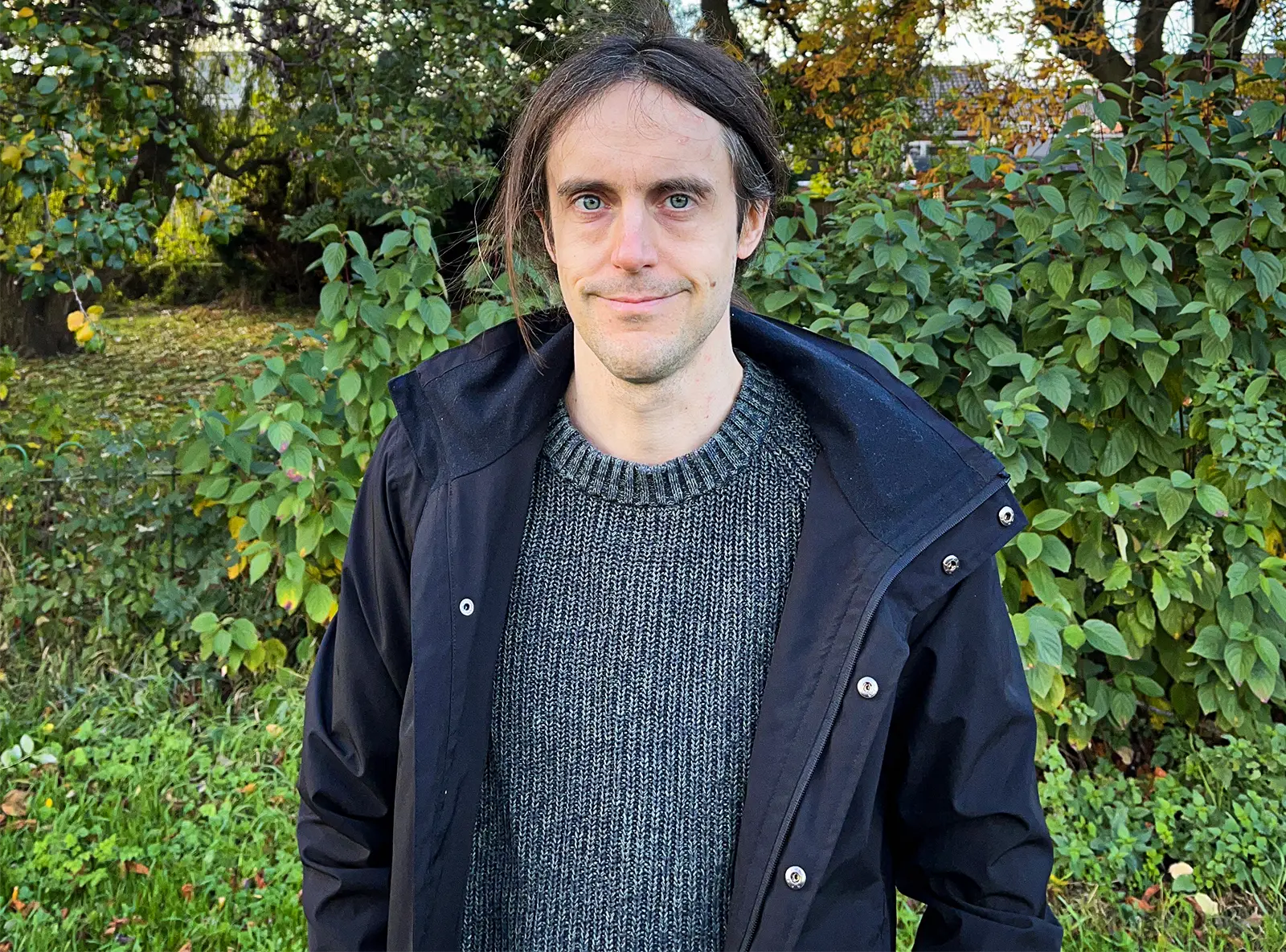
Matthew Pusey took on the debate about the nature of reality in his doctoral thesis at Imperial College London.
Courtesy of Matthew Pusey
The paradigm-shifting theorem became known as PBR, for Pusey and his academic accomplices, Jonathan Barrett and Terry Rudolph. Since the publication of PBR in 2012, many theorists have come to accept that it rules out our most commonsense understanding of reality.
“From the moment [PBR] came out, people knew it would be a landmark,” said Jacques Pienaar, a physicist now at the Federal University of Rio de Janeiro in Brazil.
At the time, Pienaar, like Pusey, had been walking in Einstein’s footsteps, dabbling in theories designed to show that objective reality exists and that quantum mechanics merely describes our incomplete knowledge of it. But when the PBR theorem appeared, Pienaar remembers thinking, “That’s it. The program’s dead.”
This is the story of how Einstein, Bell, and finally Pusey and his collaborators killed reality as we know it. In three theorems, they proved that quantum mechanics is incompatible with the world we perceive. And since experiment after experiment — including a recent realization of PBR — has established that quantum mechanics is the law of the land, something about reality has to go.
The question that remains is: How much do we have to give up?
Einstein and Reality
After playing a pioneering role in developing the theory of quantum mechanics, Einstein turned around and attacked it. He couldn’t accept what it said about reality.
Einstein knew in his bones what reality was. It was the sum total of all objective facts — like the color, position, and velocity of a billiard ball — that exist in the objects they describe, independent of perception and mind. But quantum mechanics, as developed by Werner Heisenberg and Erwin Schrödinger in the mid-1920s, didn’t deal in facts.
Quantum mechanics deals in possibilities. Its mathematics gives you a “quantum state,” also known as the wave function. This wave function can tell you, for example, that in an experiment measuring the color of a particular billiard ball, you will have a 77% chance of finding the ball to be red and a 23% chance of finding it to be green.
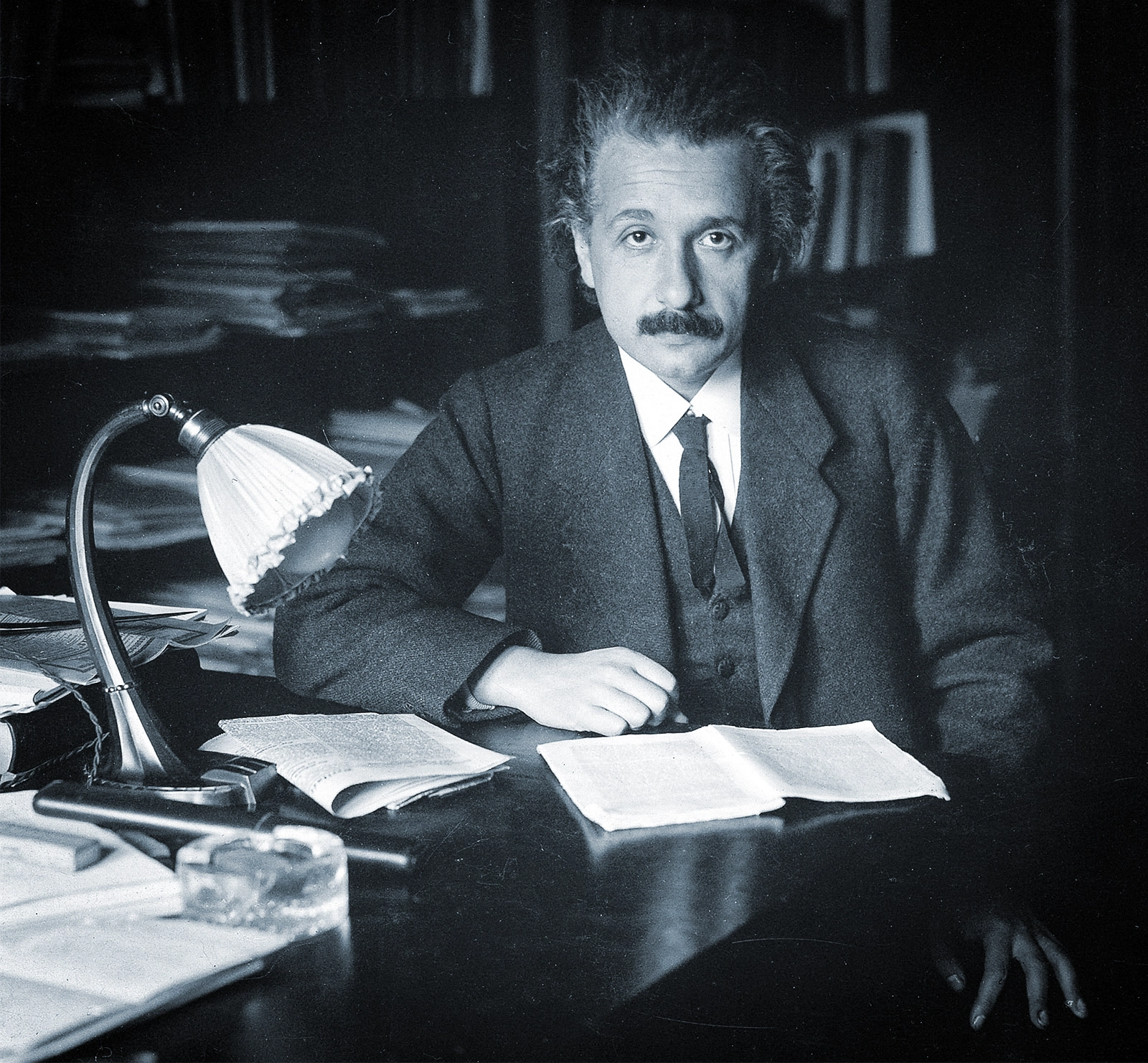
Albert Einstein’s argument that particles should have real properties that quantum mechanics can’t capture became known as the Einstein-Podolsky-Rosen paradox.
Public Domain
The question that has stumped physicists for a century is: What is the nature of the ball before the experiment takes place? Does the ball have multiple colors? No color? Does the concept of color not have a meaning? In short, is there a reality to support the object permanence we experience?
To Einstein, the answer was obvious: Of course reality exists; the wave function just doesn’t fully capture it.
In this view, the wave function is like a weather forecast. Say you wake up and your weather app tells you there’s a 77% chance that it will rain today, but you haven’t looked outside to see what’s going on. Then you raise the blinds and see raindrops falling. In that moment you become 100% certain that it’s raining. This shift from 77% to 100% is a shift in certainty that occurs purely in your head. It doesn’t reflect some real meteorological change. The atmosphere is real, and your (un)certainty about its state is something else — a reflection of the information in your mind.
Einstein, along with his collaborators Boris Podolsky and Nathan Rosen (collectively, “EPR”), came up with a thought experiment to prove that the quantum state exists only as an artifact of information. To understand the thought experiment, you need to know one peculiar thing about the wave function: Its mathematical structure doesn’t allow an object to have a position and a momentum at the same time.
The EPR experiment involved bouncing two particles off each other and, sometime later, making a measurement, such as how far one particle had traveled. This first measurement would also tell you how far the partner particle had traveled. EPR argued that the position of the partner particle had to exist, because it could be known. They argued that the partner particle also had a momentum, because that property was knowable in a similar way.
Crucially, their experiment involved measuring only one particle one time, while the other remained untouched. This showed, the scientists argued, that the second particle had properties that were set and real, even before measurement. And since the wave function doesn’t allow for that, the wave function must not reflect the literal state of the particle; the quantum state is not real.
To reach this conclusion, the scientists had made two seemingly unassailable assumptions. First, they assumed that it was possible for a particle to have a literal state, the assumption of “reality.” And second, they assumed that this literal state existed within the particle and nowhere else, so the only way to change it would be to interact with the particle, the assumption of “locality.”
But just months after EPR, Heisenberg’s mentor, Niels Bohr, tried to shut down Einstein’s argument by attacking its first assumption. “There is no quantum world,” Bohr would later say, according to his assistant Aage Petersen. “There is only an abstract quantum physical description.” His argument was akin to asserting that the weather forecast was accurate but that the atmosphere itself was either nonexistent or indescribable. This denial of objective reality became known as the Copenhagen interpretation.
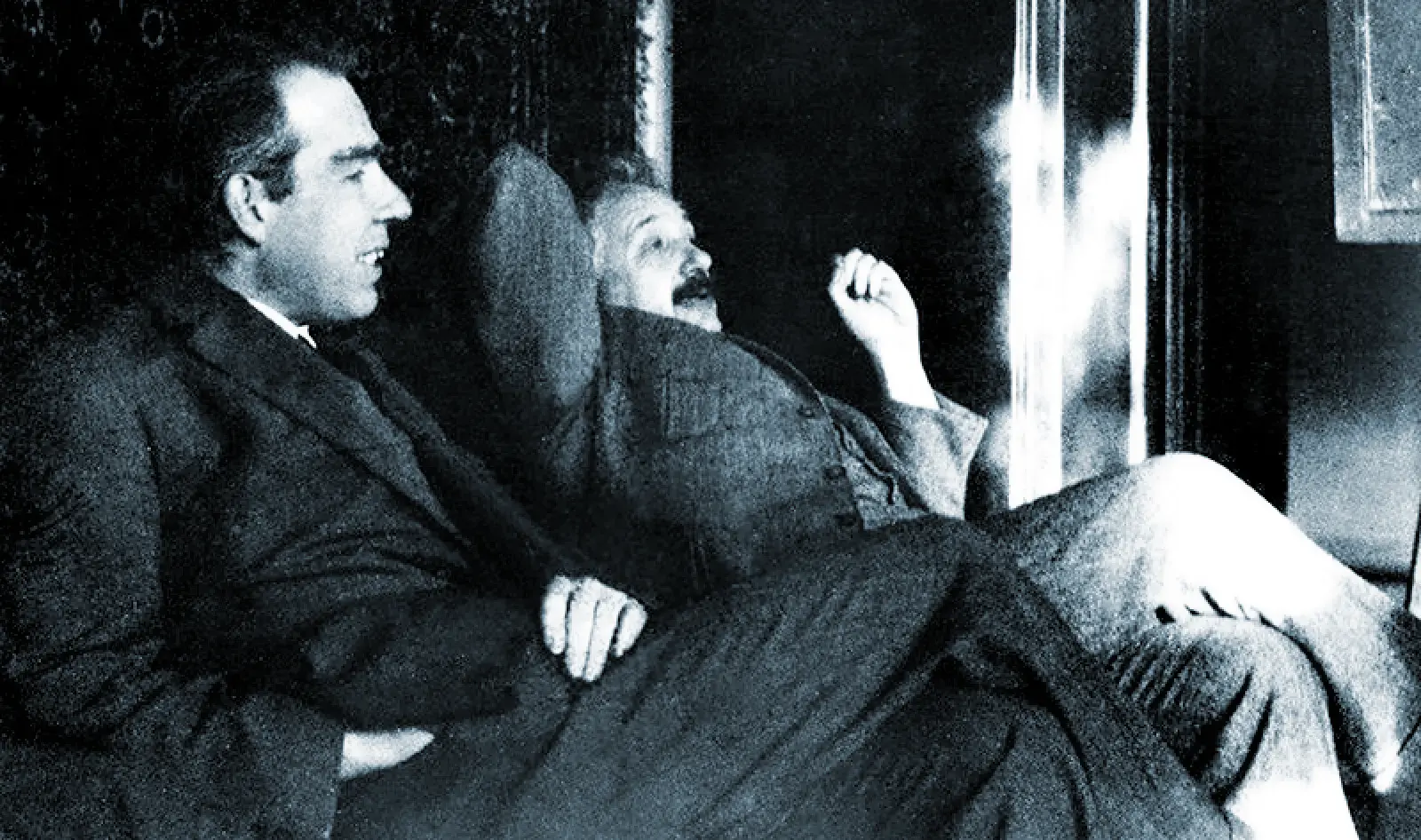
Niels Bohr engaged in a sustained public debate with Einstein in the 1920s and ’30s about the implications of quantum mechanics.
Public Domain/Paul Ehrenfest
Many modern quantum physicists criticize Bohr’s response to EPR for being confusing and vague. But Bohr’s prominent role as a founder of quantum mechanics, together with the mounting experimental support for the theory, convinced many of his contemporaries that he was right. Physicists largely lost interest in debating how the quantum state relates to reality — the central question in the modern field of “quantum foundations.”
“Bohr is like the worst thing to happen to physics,” said David Schmid, a physicist at the Perimeter Institute for Theoretical Physics in Waterloo, Canada, who devoured the Bohr-Einstein debates as a teenager. “He’s the reason that quantum foundations didn’t exist” until the modern era.
Thirty years later, a blockbuster theorem would revive physicists’ curiosity.
Bell and Locality
John Stewart Bell always felt sympathy for Einstein. As a student, Bell also struggled to swallow the surreality of quantum mechanics. He wondered how its predictions could possibly be disconnected from a real world made of objective properties, as Bohr had advocated.
Then, in 1952, Bell “saw the impossible done.” He read the works of David Bohm, which developed a version of quantum mechanics where particles always had real positions, regardless of measurement.
“Bohmian mechanics” accomplished this by declaring the wave function a “pilot wave,” a physical object that steered particles around. As a real thing in the world, this wave had one distasteful feature: nonlocality. It could change in such a way that it could disturb a distant particle instantly.
Despite this drawback, the pilot wave was a beacon to Bell. It allowed physicists to argue that, contrary to the popular Copenhagen interpretation, an objective reality existed after all. “Why is the pilot wave picture ignored in textbooks?” Bell wrote. “Should it not be taught, not as the only way, but as an antidote to the prevailing complacency?”
Bohm’s work inspired Bell to devise a new thought experiment, one so simple that it would apply to all versions of quantum theory, known and unknown. Following in Einstein’s footsteps, he imagined two particles colliding and flying off in opposite directions. Eventually, the particles would each encounter a device that would perform a randomly selected measurement, one with two possible outcomes.
Bell imagined repeating this experiment many times and used basic arithmetic to predict how often the devices could possibly return matching measurements. He assumed that each particle had a state to begin with (Einstein’s idea of objective reality) and that the devices were too far apart for the particles to influence each other (Einstein’s idea of locality). He calculated that, in a real and local world, the particles would match relatively rarely.
Then, using quantum mechanics, Bell predicted that the two particles would match much more often. He had created an experimental test that could pit quantum mechanics against Einstein’s version of reality. Physicists carried out his experiments in the 1980s and confirmed that particles really do match more than Einstein’s reality would allow.
Bell had succeeded where Bohr failed: He had proved that at least one of EPR’s two key assumptions had to be wrong. Physicists saw that the world could not be both real and local. Something had to give.
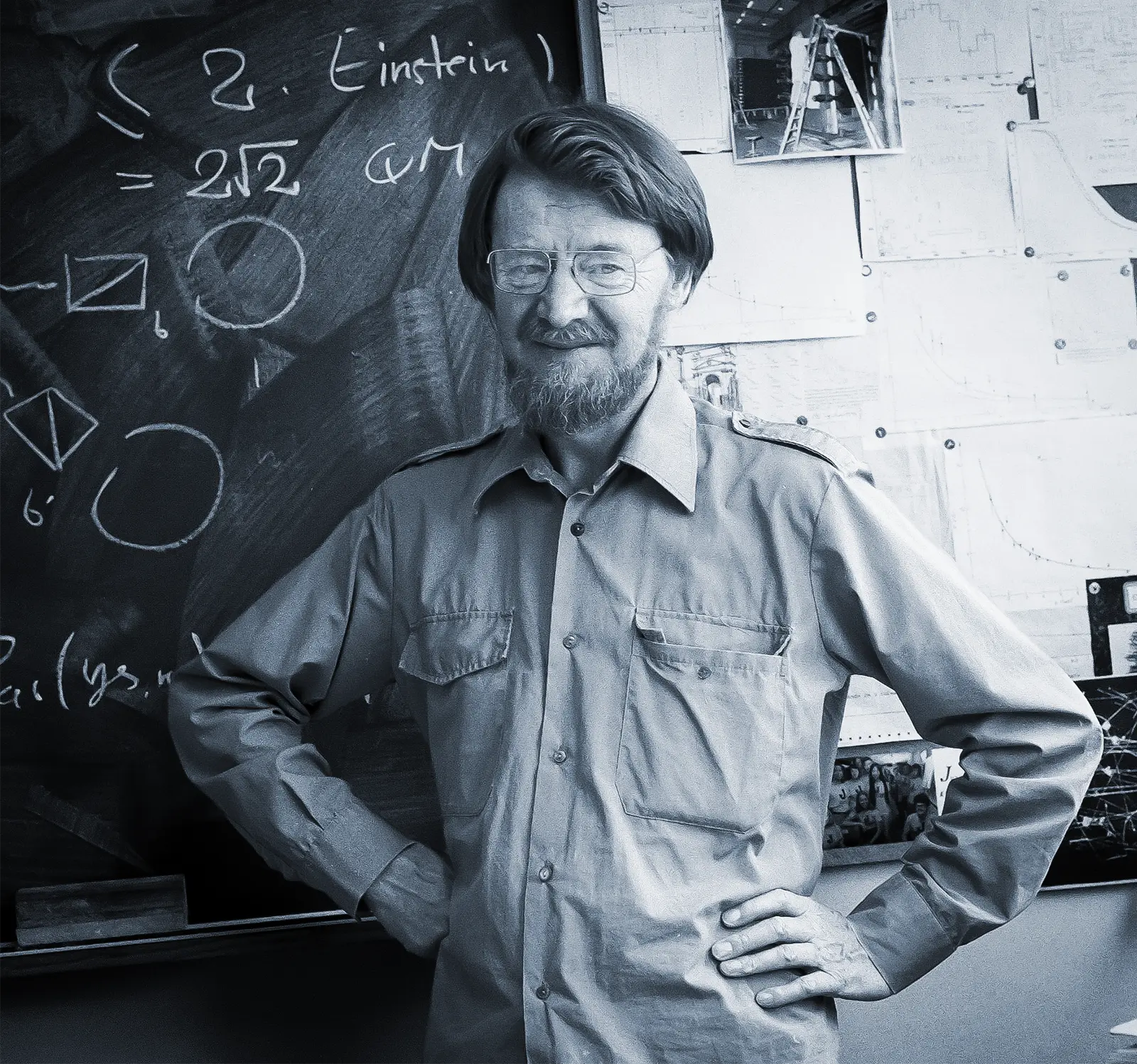
John Stewart Bell set out to defend Einstein’s idea of reality, but Bell’s thought experiment revealed a weakness in Einstein’s argument.
CERN/CC BY 4.0
Bohmian mechanics represented one extreme way of navigating the trade-off. It saved reality by making the wave function a real object, but it demanded that people swallow the bitter pill of nonlocality. The Copenhagen position, that nothing was real, was another extreme.
In the following decades, some physicists realized that there was a middle path. Bell had shown EPR’s assumptions to be wrong, but perhaps Einstein was nevertheless onto something with his intuition that the wave function resembled our knowledge, like a weather forecast.
“You go back and look at everything [Einstein] wrote, and it’s just 100 years ahead of its time,” Schmid said.
The search for a way to preserve objective reality without making the wave function real would lead Pusey to the PBR theorem. And in an ironic twist, the PBR theorem would effectively end that search.
PBR and Information
Physicists like Schmid and Pienaar couldn’t get over the fact that the quantum state just didn’t act like an understandable physical property.
Take one defining behavior of the wave function, its “collapse.” Recall the example of the billiard ball that could be red or green. At the moment you look at the ball, its wave function collapses, giving it 100% odds of redness.
Trying to interpret this event as a literal change in the physical ball is maddening. Did the ball begin as some impossible-to-visualize colorless mixture, and then, in the instant you glanced at it, snap into a state of 100% redness?
“You have to watch out for your sanity in a field like quantum foundations,” said Lucien Hardy, a physicist at the Perimeter Institute who works in the field.
But interpret this event instead as a change of information inside your head, and it makes much more sense. You thought the ball was probably red, looked, and learned that indeed it was. The same thing happens to the odds of rain when you look outside your window in the morning. Einstein didn’t put it quite in these terms, but this position is what modern scholars believe he was advocating for in EPR.

In 2004, Robert Spekkens, a physicist at the Perimeter Institute, laid out a theory of a simple world like the one Einstein had imagined. In this theory, each particle has an objective position and velocity, but experimental limits make it impossible to measure both exactly. Spekkens showed that in such a world, one where the quantum state represents incomplete knowledge of real properties, he could produce a laundry list of putative quantum phenomena — quantum “teleportation,” a ban on copying quantum states, and dozens more. His research amassed a pile of fresh evidence that the quantum state looks a lot less strange if you move it from the external world into someone’s head. In other words, he showed that Einstein’s approach still had advantages, despite its faulty assumptions.
In 2011, Spekkens’ work came to the attention of Pusey, then a graduate student. Bell’s theorem had already hooked Pusey with its guarantee that quantum mechanics means the world really is more bizarre than Einstein, or common sense, would have it. “We’ve got this theory that says we’re not just imagining it,” Pusey said. “There really is something strange to figure out here.”
Spekkens’ theory hinted that while not all of the strangeness of quantum mechanics could be banished (Bell’s theorem guaranteed that), perhaps some of it was an illusion caused by taking the wave function too seriously. After all, Spekkens’ theory didn’t look so different from full-blown quantum mechanics on paper. After Pusey rewrote it in a notation he developed, it differed by only a few minus signs. His collaborators, who were Einstein sympathizers, encouraged him to try to upgrade Spekkens’ theory, minimizing the weirdness as much as possible by treating the wave function as a state of knowledge that lives in your head.
“I spent a few days trying to do that, and got fed up,” he said. “So I decided to prove that it was impossible instead.” That work would become the PBR theorem.
Like EPR, PBR explores a question about reality in the form of an elaborate thought experiment. PBR proposes an odd sort of game that you can imagine as a card game between a dealer and a player, following an analogy of Rudolph’s. First, the dealer pulls the 26 red cards out of one deck of cards and the four aces out of another. Let’s call them the red pile and the ace pile.
Next, the dealer places the two piles of cards under the table. He randomly chooses a card from either the red pile or the ace pile. Then he repeats the process, randomly choosing a second card. He then places the two cards face down on the table and gives the player a strange challenge: Tell me one combination of piles from which these two cards were not selected.
Most of the time, the player is guaranteed to win. Say she turns the two cards over and sees the two of diamonds and the ace of clubs. Obviously, the two of diamonds — a red non-ace — came from the red pile. And the ace of clubs — a black ace — came from the ace pile. The dealer could not have gotten these cards by choosing from the red pile twice, or from the ace pile twice, so the player can definitely win by naming either of those options.

But say the player turns over the ace of diamonds and the ace of hearts, two red aces. Since both cards could have come from either pile, the player has no way of ruling out any possibilities. She can guess, but she has only a 3-in-4 chance of guessing right. And so after enough rounds, she must eventually lose.
The point of this game is to illustrate the fundamental difference between real states and states of knowledge. “Ace of diamonds” and “ace of hearts” are the real states of the cards, while “red pile” and “ace pile” are states of knowledge. The player sometimes loses because information about each card’s pile of origin is not written into the card itself; it lives only in the head of the dealer.
This distinction exists only because the two states of knowledge share real states — the red aces. This is a fundamental property of states of knowledge; they “overlap” in a way that makes the which-pile state unreadable from the physical card. Consider, in contrast, playing the same game with non-overlapping piles, like red cards and black cards. In that case, turning over a card would reveal with certainty which pile it had come from. Both “red pile” and “four of hearts” would be real states of the card itself.
PBR posed a quantum version of the game and asked whether the quantum states could overlap, and whether quantum states could therefore be states of knowledge. This game — and its conclusion — shares two crucial assumptions with the classical version. It assumes that the cards have real states (Einstein’s idea of objective reality). And it assumes that the real state of the first card drawn does not affect the real state of the second card drawn (a new assumption distinct from locality).
The surprise was that in the quantum version of the game, the player could always win. To show this, PBR detailed how to assemble a quantum machine built from doohickeys that perform simple quantum actions like putting classical objects into quantum states. If you scan the two cards with this machine, it can always rule out at least one combination of piles they come from. (In a strange quantum quirk, the machine does this — and in fact needs to do this — without turning over and observing the cards.)
A 2012 experiment showed that this guaranteed-win quantum strategy really works, demonstrating that there is no overlap between quantum states. Therefore, given PBR’s assumptions, quantum states are not states of knowledge in the dealer’s head; they are indeed scannable properties of the cards themselves. “You can think of [the quantum state] as stamped onto the underlying state of the world,” Pienaar said. “You change the quantum state, you change something in reality.”
Life After PBR
As with Bell, PBR has been experimentally confirmed multiple times. Last fall, for instance, researchers in the U.K. played an expanded version of the PBR game, dealing out five cards instead of just two, using a quantum computer built by IBM. Indeed, the quantum machine always won, although no one had doubted that it would. In fact, the researchers had been using the PBR theorem mainly to check whether the quantum computer was functioning properly. The validity of quantum mechanics — and PBR — was taken as a given.
“That was really the motivation,” said Crispin Barnes, a physicist at the University of Cambridge who led the experiment, “to see whether a theorem from quantum foundations could also be turned into [an] experimental probe of genuinely quantum behavior.”
Many physicists have taken PBR to mean that the quantum state must be real — an objective property living in particles, people, and planets. If so, impossible-seeming events like collapse must also have some physical correlate. This stance amounts to taking the extreme path of Bohmian mechanics and other “realist” interpretations. As Pusey pithily puts it, PBR guarantees that “if anything is real, the quantum state is real.”
But to conclude that the quantum state is definitely real is to misunderstand the PBR theorem, because PBR also leaves open the other extreme path: It could be, as the Copenhagenists have steadfastly maintained since the days of Bohr, that in some sense nothing is real, including the quantum state. It’s perfectly possible that the quantum state lives in our minds and has no direct connection to an objective reality. In this case, the redness of the billiard ball would be inextricably linked with the act of observing it — precisely the state of affairs that so deeply offended Einstein. “Do you really believe the moon is not there when you are not looking at it?” Einstein once famously pressed his colleague Abraham Pais.
PBR doesn’t give us the answer. What it does do is end a century of bargaining with quantum mechanics. By ruling out the possibility that reality is real while the wave function is not, PBR requires that physicists either fully embrace the notion of an objective but entirely surreal reality, or fully reject objective reality altogether. “Do you bite the bullet, or do you try and dodge the bullet?” Pusey said.
Pienaar was one of the few physicists who were still playing around with middle-of-the-road theories, though with waning interest. PBR contributed to his choice to give up on objective reality once and for all. He switched to a modern offshoot of Copenhagenism known as QBism.
QBism asserts that the world itself may exist, but quantum mechanics can’t describe it. All the theory can really do is capture our relationship to — and subjective experience of — the world. “You need two to tango,” Pienaar said. “Without two systems, there’s no relation. And reality is nothing but relations.”
And yet, some physicists remain unsatisfied with the two extreme options: a surreal reality or no reality. So they are beginning to pick at the fine print on the technical definition of reality. “Maybe the correct way of thinking about a state of reality is something a bit more woolly, that doesn’t quite fit into this straitjacket,” Pusey said.
In this spirit, Hardy questions whether reality needs to necessarily have a single, objective state at every given moment. Perhaps states could somehow spread out across multiple moments. He doesn’t yet have a fully fleshed-out proposal, but his goal is to come up with a deeper, more general notion of reality that is still recognizable.
If underdogs like Hardy succeed in saving some notion of reality, it won’t quite be the one Einstein wanted; Bell and PBR guarantee that. But it may yet turn out to be the sort of reality Einstein needed, one that makes enough intuitive sense to win the hearts and minds of physicists, especially those fatigued from a lifetime of labyrinthine debates about what is real. “It needs to have the ring of truth, so that when people see it, they can’t unsee it,” Schmid said.