Novel Experiments Expand the Hunt for ‘Ultralight’ Dark Matter

Celsius Pictor for Quanta Magazine
Introduction
For the most part, we are blind to the universe.
Almost a century ago — in 1933, to be exact — Fritz Zwicky’s studies of distant galaxies led him to suggest that “dark matter is present in very much greater density than luminous matter.” Observations by the astronomer Vera Rubin would later substantiate the case for the intangible, leading her to write in 1980 that “the conclusion is inescapable that non-luminous matter exists.” The elusive stuff appears to react with ordinary matter only through gravity, allowing scientists to estimate how much of it there is. Beyond that, we know very little.
That’s not for lack of trying. Elaborate detectors across the globe have failed to catch any glimpse of dark matter. If you also consider dark energy, which accelerates the expansion of the cosmos, “more than 90% of the matter-energy contents of the universe are unknown,” said Atsushi Taruya, an astrophysicist at Kyoto University in Japan. “That’s a bit embarrassing.”
As null results pile up, scientists are expanding the search, particularly for the tiniest candidates, called ultralight dark matter. Some of the more inventive experiments involve clouds of atoms in quantum superpositions, minuscule levitating magnets, nuclear atomic clocks, and Earth’s geomagnetic field itself. One of these approaches may yield a clue to a whole new realm of physics.
Problem Solver
Ultralight dark matter wasn’t always a popular target. For decades, the leading candidate was a “weakly interacting massive particle,” or WIMP, but tests have steadily ruled out WIMPs with different characteristics. In September 2026, researchers working on an experiment called Lux-Zeplin said they had detected a mysterious particle collision in an underground vat of liquid xenon. The cause could have been a WIMP, but many scientists remain skeptical because the collision was so energetic — if WIMPs can have that much energy, several lower-energy collisions should have been detected already. As with other compelling apparent WIMP detections, the peculiar signal may have been a false alarm caused by rare interactions with background particles or a flaw in the data analysis.
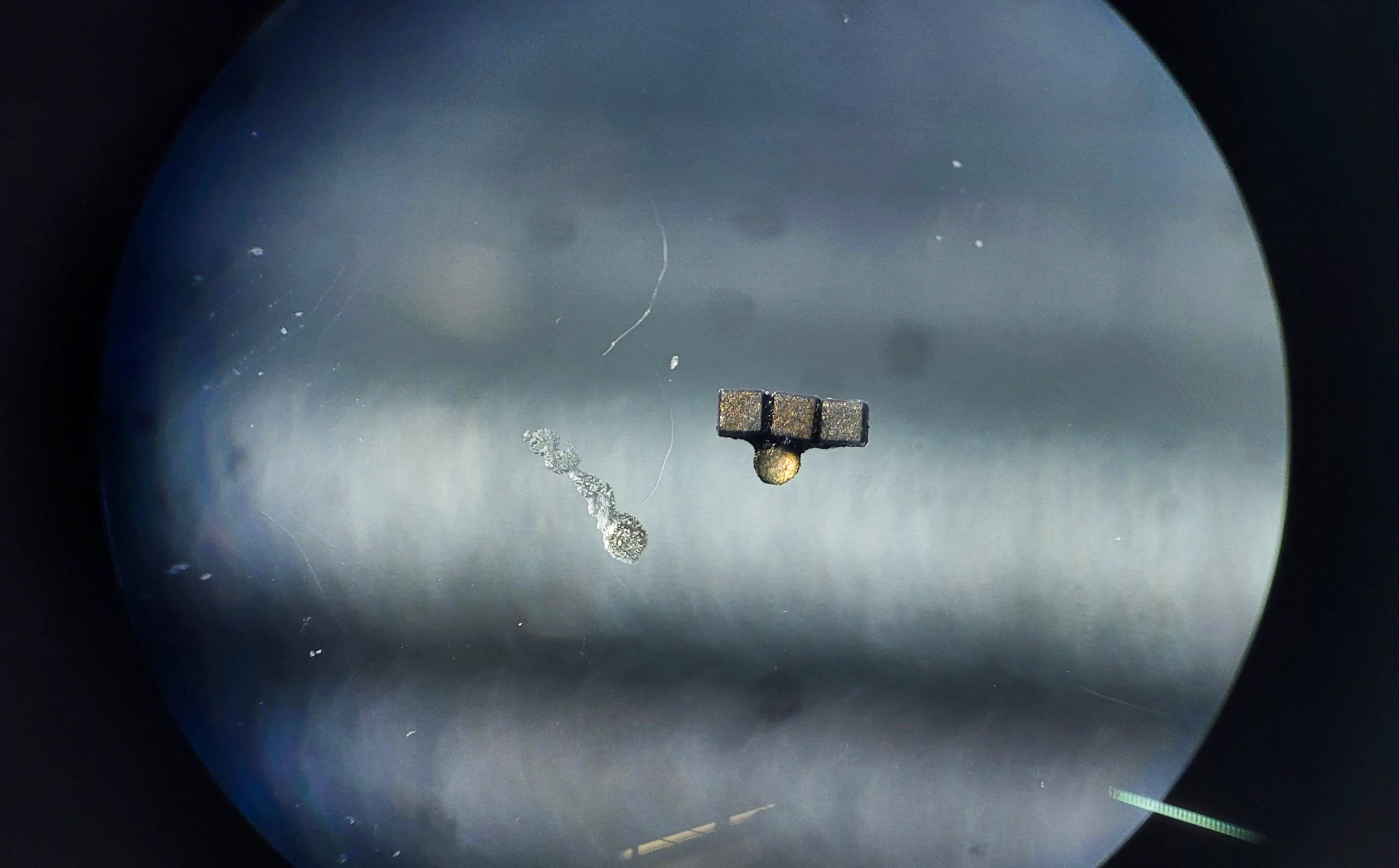
A tiny magnet, less than a millimeter wide, levitates in a vacuum. A bump from ultralight dark matter would amplify the natural swaying of the magnet.
Dennis Uitenbroek and Tjerk Oosterkamp, Leiden Institute of Physics
The September blip could end up marking one of the last gasps of the WIMP era. For years now, WIMP searches have been giving way to the hunt for lighter particles — particles so wispy that they would behave more like immense waves flowing through space.
For many scientists, the most appealing ultralight dark matter candidate is the axion. Named in the 1970s for a laundry detergent, this hypothetical particle would clean up a major problem in physics.
The problem concerns the neutron, which is made up of fundamental particles called quarks with opposing electrical charges. According to theories governing the strong nuclear force — the force that holds together atomic nuclei — these charges should be slightly offset. But precision measurements find them almost perfectly aligned, a mystery known as the strong CP problem. A hypothetical field of axions would pull the neutron’s internal charges into the observed alignment.
But searching for axions is a painstaking process. If they account for all or most dark matter, theories suggest that a single axion should be about a trillionth to a billionth of the mass of an electron. So far, physicists have explored only a tiny fraction of these possibilities.
One axion-hunting tool is a haloscope, a hollow device with conductive metal walls placed inside a strong magnetic field. If axions from space fly through the magnetic field inside this cavity, they should convert to photons, producing an electromagnetic signal that the experiment would amplify.
The challenge is that, for every possible axion mass, you need a different size detector. For the lighter axions, the cavity needs to have a diameter about that of a beer keg. For heavier axions, you need a smaller cavity. Haloscopes such as the Axion Dark Matter Experiment at the University of Washington have thoroughly searched much of the lighter range without finding anything.
At Yale University, the physicist Reina Maruyama and her colleagues are developing a haloscope filled with an array of copper rods that alter the experiment’s electromagnetic field. The new setup will let them search for higher-mass axions. Other possible designs split the cavity into segments, either with thin conductive walls or with honeycomb-shaped metal tubes.
These modified haloscopes should allow scientists to slowly test unexplored segments of the axion’s mass range. But to search for particles outside this range, researchers need entirely new setups.
Dark Worlds
While the axion could solve the strong CP problem, it may not account for all dark matter. In fact, many physicists argue that we shouldn’t assume dark matter is just one particle. Visible matter, after all, is a particulate soup of many ingredients.
“The world that we normally interact with, it comprises all sorts of different particles,” Maruyama said. “It’s possible that … there’s a whole other world out there that is not, at the moment, visible to us.”
Some physicists believe dark matter could consist of dozens or hundreds of axionlike particles.

The ALPS II experiment at DESY is formally known as a “light shining through a wall” experiment.
© DESY/Heiner Müller-Elsner
To search for them, researchers are currently upgrading a 300-meter-long apparatus in Germany known as a “light shining through a wall” experiment. The setup runs a high-powered laser through a magnetic field. The idea is to convert photons to axionlike particles, which would then pass through a barrier that blocks light. On the other side, a second magnetic field would convert the particles back to photons.
“The goal would be to open up the window to the dark sector of nature,” said Axel Lindner, a physicist who works on the experiment at the German Electron Synchrotron (DESY).
Another approach is to use Earth’s magnetic field as a detector. A group in Japan including Taruya recently analyzed 10 years of data from a magnetometer in Scotland, searching for possible axionlike particles in our planet’s ionosphere. They found 65 electromagnetic signals that match the type of signal expected from ultralight dark matter. But to conclude that a signal is from dark matter, scientists would need data from all around the globe, because Earth’s magnetic field varies at different locations.
Taruya’s team is planning to analyze additional data taken in Japan, where the signal from any axionlike particles is expected to be different. With time, perhaps scientists will be able to read the signs of dark matter in the sky.
Wave Riders
Axionlike particles may reveal themselves by converting to photons in magnetic fields, but detecting other types of ultralight dark matter requires a different approach. Such particles behave like immense fields oscillating in space. With the right setup, scientists may be able to detect the ebb and flow of these dark waves.
“Theories predict that, if there is this background density, and we’re moving through it like in a spaceship, then we should be able to probe this density because it very weakly couples to quantities we can observe,” said Thorsten Schumm, a physicist at the Vienna University of Technology.
Schumm leads a team that recently developed a new type of atomic clock called a nuclear clock. Traditional atomic clocks measure the frequency of light needed to push an atom’s electrons into a higher energy state, but nuclear clocks pinpoint the frequency required to excite the nucleus itself.

In this nuclear clock experiment, an ultraviolet laser pushes thorium nuclei to a higher energy state. A passing dark matter wave could interfere with this transition.
©T. Schumm, TU Wien
In particular, nuclear clocks use thorium-229, an isotope of thorium in which two nuclear energy levels are nearly the same. This allows scientists to trigger the internal transition with ultraviolet lasers. It also makes the clock extremely sensitive to any outside influences on the nucleus, such as interference from a passing dark matter wave.
Already, the nuclear clock in Vienna has set new constraints on ideas that describe how ultralight dark matter could couple to photons and the strong force. “It’s really just a freak-of-nature coincidence that there are two bound states of the nucleus … [that] are almost exactly identical,” Schumm said.
Another tool that could pick up these dark waves is an atom interferometer. These instruments cool a cloud of atoms to nearly absolute zero, coaxing it into a wavelike state. Lasers then nudge the cloud into a superposition, meaning that its possible location gets spread out in space. When this quantum state is broken and the wavelike atoms collapse back into particles, scientists can measure the properties of their quantum wave state.
If we are immersed in the tides of dark matter, then that dark matter might introduce measurable inconsistencies into that quantum wave state — if you can make the measurements with enough precision, that is. To that end, Oliver Buchmueller, a physicist at Imperial College London, and colleagues recently demonstrated that performing this process on two clouds of atoms at once will cancel out the noise from the lasers, allowing them to search for the effects of dark matter on their atomic clouds.
“We’ve been looking for [dark matter] for quite some time,” Buchmueller said. “Now we have to just be open to any potential incarnations.”

The Axion Dark Matter Experiment at the University of Washington has been on the lookout for axions since January 2017.
Tony Luong
The recent experiment was a proof of concept that separated the two atomic clouds by just a millimeter before putting them into superposition, which is not enough to reveal the effects of dark matter. But a larger atom interferometer designed to separate clouds of atoms by about 100 meters is currently under construction at the Fermi National Accelerator Laboratory, and another similar experiment is pending final approval at CERN. These larger instruments might just capture the undulations of dark matter waves in the next few years, when they are scheduled to begin taking data.
In theory, dark matter waves should slightly perturb everything they pass through, all the time. An international collaboration is attempting to detect these perturbations with a tiny magnet suspended in a vacuum superconducting trap. The experiment, at Leiden University in the Netherlands, is the first to search for the effects of dark matter using magnetic levitation.
“You have a levitated magnet just sitting there waiting for something to knock it around,” said Dorian Amaral, a physicist at the Institute for High Energy Physics in Spain who works on the experiment. “It’s about the size of a grain of dust.”
The speck of magnet naturally sways ever so slightly, and if that swaying is in resonance with a passing dark matter wave, the strength of the signal will become amplified, Amaral said, the way a child in a swing will soar if you push the swing at just the right moment. The team published initial findings in 2025: no dark matter spotted. But they have since upgraded the experiment to further reduce noise and levitate a larger magnet. These changes should increase the likelihood that ripples of minuscule dark matter could jostle the magnet, and they may even make it possible to detect an ultraheavy dark matter particle.
Hunting for dark matter — tuning magnetic cavities and dialing in laser frequencies, trapping clouds of atoms and combing through years of data — is slow and meticulous work. With any luck, one of these experiments will pick up a signal, registering the nearly imperceptible swell of unseen matter flowing through the universe.
Or maybe, like their predecessors, these experiments won’t find anything. If that’s the case, physicists will need to investigate other possibilities. Maybe dark matter is made up of countless primordial black holes that formed immediately after the Big Bang, an idea Stephen Hawking explored in the 1970s that has garnered fresh attention in recent years. Or perhaps we are destined to stare into space indefinitely, wondering just what it is that’s holding our universe together.