Triplet of ‘Ghostly’ Galaxies Hints at What Dark Matter Is — and Isn’t
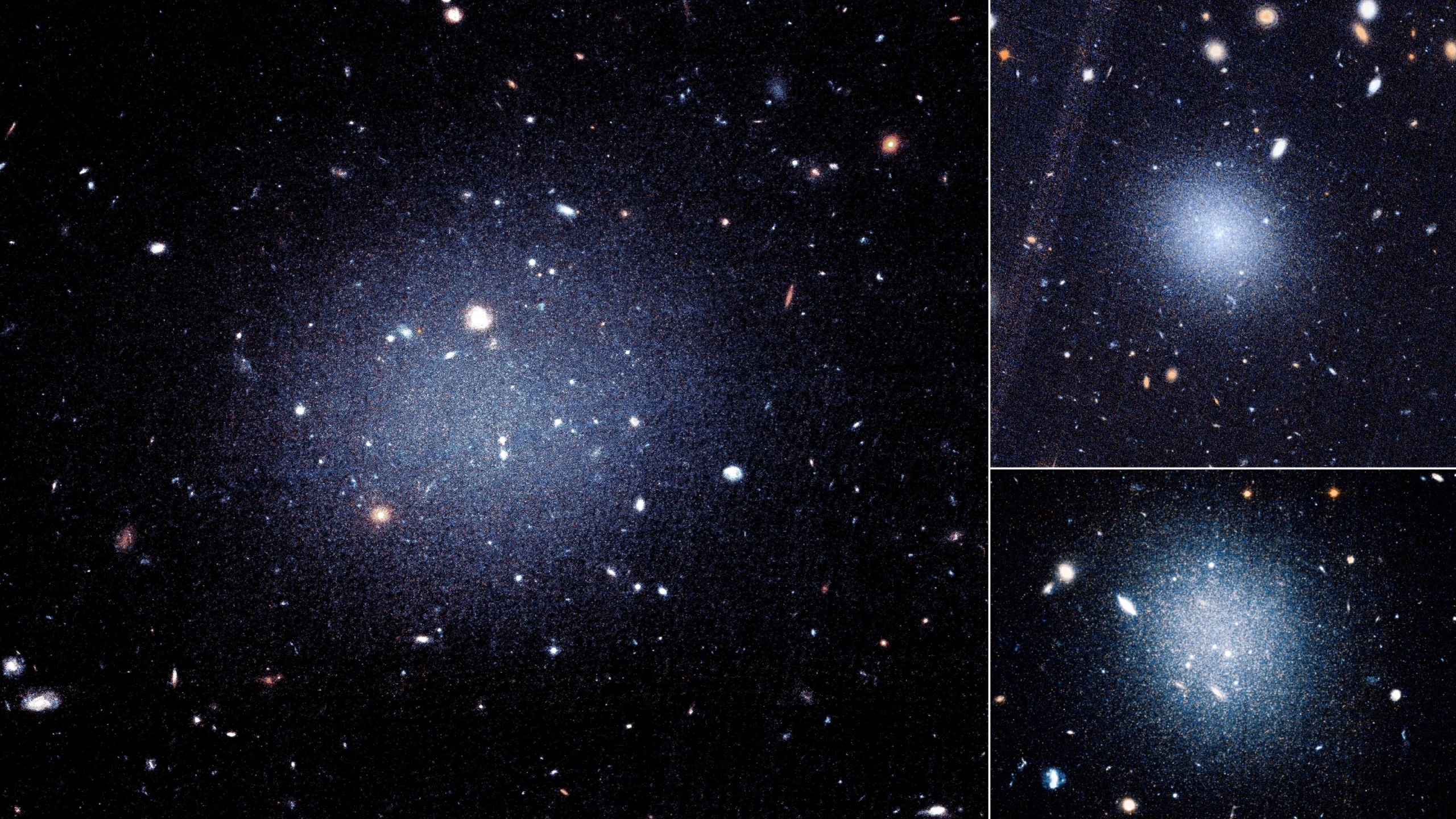
The lack of dark matter in galaxies DF2, DF9, and DF4 (clockwise from left) was a shock to scientists, who speculate that they formed after an ancient collision.
Introduction
About 65 million light-years from Earth, three galaxies don’t look quite right. They aren’t whirlpools bursting with light, but pallid objects dimly illuminated by a smattering of stars. “They have this ghostly appearance,” said Michael Keim, an astrophysicist at Yale University. And this isn’t even the weirdest thing about them.
Dark matter is the invisible glue that keeps the largest structures in the cosmos together. It draws ordinary, visible matter toward it, allowing stars to form and keeping the stelliferous limbs of galaxies from flying off. “Almost all galaxies are dominated by dark matter,” said Shyam Balaji, a theoretical physicist at King’s College London.
But these three diffuse galaxies, known as DF2, DF4, and DF9, have left astronomers stunned. After using a suite of telescopes to estimate their masses — using the motions of their stars as a proxy — the researchers found that all three have little dark matter. Instead, a pittance of ordinary matter alone must have forged their small selection of stars. How could these rule-breaking galaxies have formed?
A paper published in June 2026 in The Astrophysical Journal offers a potential solution. Once upon a time, two regular galaxies collided. Their ordinary matter — their gas and dust — swirled about and got clumped up. But the dark matter passed right through and continued on, like a specter passing through a wall. The cosmic pileup left behind three new galaxies, each bereft of dark matter, each left to struggle to form a new batch of stars.
It’s a convincing explanation for many experts — one that, crucially, may tell us something about the mystery of dark matter.
Some scientists have suggested that dark matter, which has yet to be directly detected, may not exist. Instead, they propose that a tweak to our understanding of the gravitational force might explain various features of the universe.
These bizarre galaxies pour cold water on that idea. “What this is showing is that dark matter is … not just a modification of gravity,” said Keim, who is an author of the new study. If you segregate ordinary matter from dark matter, you’d expect that the dark matter–lacking galaxies would struggle to form stars — and that’s what DF2, DF4, and DF9 show.
That suggests, as many have suspected for some time, that dark matter is a physical thing. “The absence of dark matter is, in a way, some evidence of dark matter, which is ironic,” Balaji said.
Dark Ghosts
What, exactly, is dark matter? Ever since it was formally proposed by the astronomer Fritz Zwicky in the 1930s — and built upon in the 1970s by the astronomer Vera Rubin — cosmologists and astrophysicists have been putting forward their best candidates. Could it be a stealthy type of neutrino? Might it be so-called weakly interacting massive particles, or WIMPs? Some have even opined that it could be primordial black holes as small as individual atoms and as old as the universe itself.
“We don’t know which dark matter candidate is the right one,” said Daniel Whiteson, a particle physicist at the University of California, Irvine. Whatever it is, it has yet to be detected. But “there’s a lot of independent lines of evidence that dark matter is matter.”
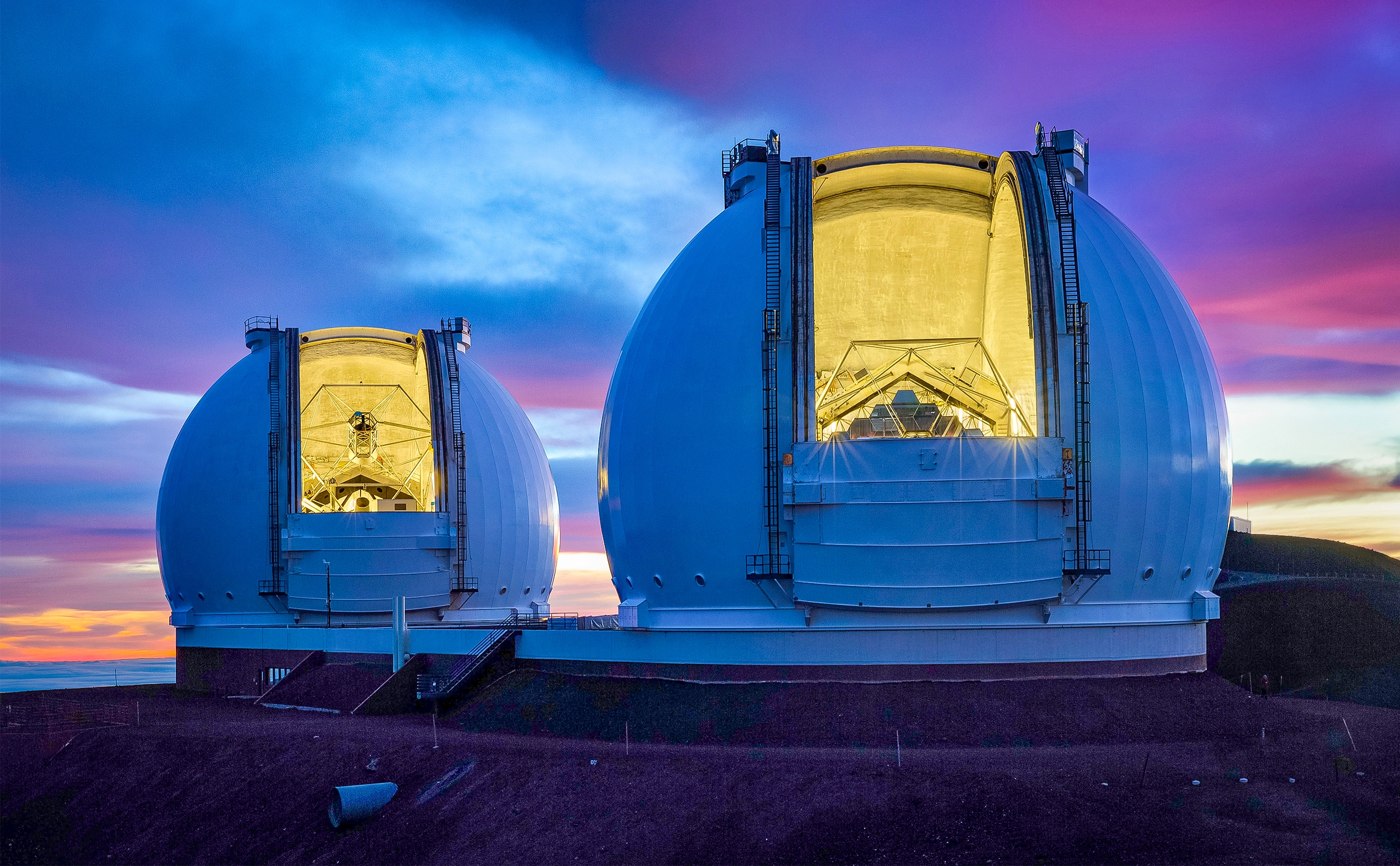
In 2018, scientists used observations from the Keck Observatory in Hawai‘i to estimate the mass of galaxy DF2. They discovered that it contained 400 times less dark matter than expected.
WM Keck Observatory/Ethan Tweedie
Dark matter, which makes up 27% of the universe — and 85% of all matter —interacts with gravity. If it were down to the gravitational pull of ordinary matter alone, stars on the edges of rapidly spinning galaxies would escape into space. Ordinary matter alone would struggle to clump together tightly enough to form stars. Dark matter also seems to warp space itself, bending light around objects in a process known as gravitational lensing.
“You wouldn’t get galaxies without dark matter,” said Chamkaur Ghag, a physicist at University College London. “Is there a way of evolving the galaxies without dark matter in the first place? Our understanding says no.”
So when DF2 was discovered in 2018, astronomers didn’t quite know what to make of it. The galaxy is roughly the same size as the Milky Way, but with 200 times fewer stars, it’s considerably dimmer. Suspicious, scientists used the Keck Observatory in Hawai‘i to track the motions of those stars to estimate its total mass. They discovered that, even for such a star-deficient galaxy, it was lightweight: It seemed to contain, at most, 400 times less dark matter than they would expect, making DF2 the first dark matter–deficient galaxy ever spotted.
In 2019, they observed DF4, another phantom galaxy with a dearth of dark matter. And in 2026, scientists announced that a third, DF9, had joined the club. It contains the mass of roughly 100 million suns, which is consistent with having only ordinary matter. If it were also packed with dark matter, it would be 100 times more massive.
That all three gossamer galaxies existed along a line, as neighbors, didn’t escape the attention of astrophysicists, who began to coalesce around an origin story.
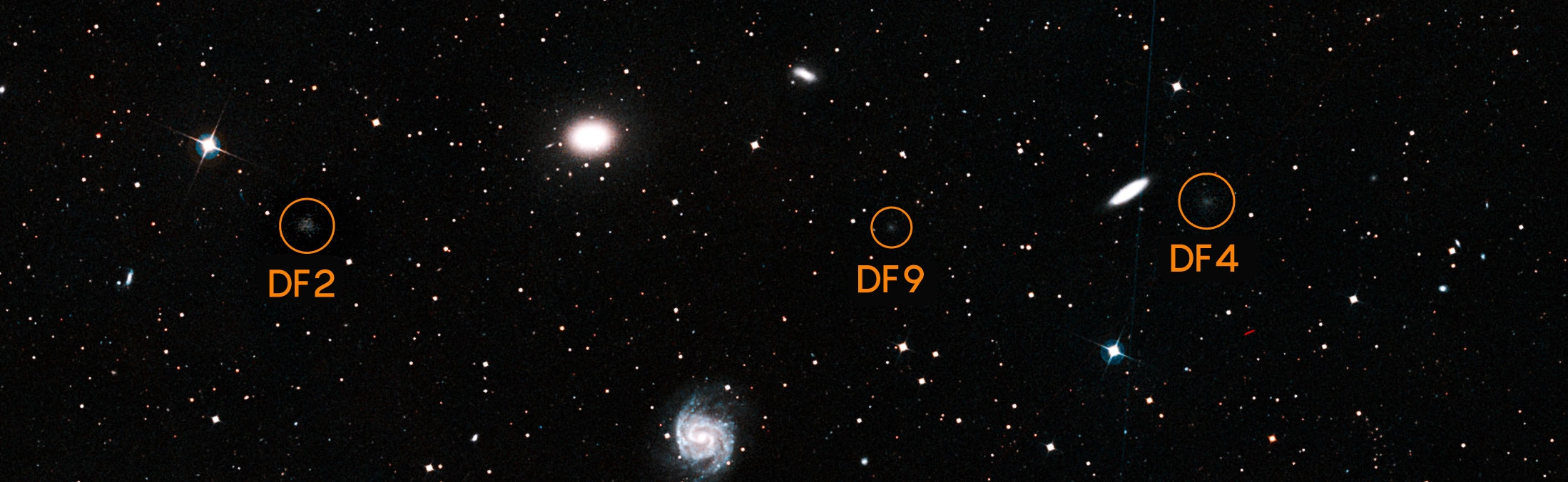
This image from the Hubble Space Telescope shows neighboring galaxies DF2, DF9, and DF4. An ancient smash-up may have stripped away their dark matter, leaving only ordinary matter behind.
ESA/Hubble/NASA/Digitized Sky Survey 2/Acknowledgement: Davide de Martin
Dark matter is only known to act with the gravitational force; there’s no compelling evidence yet that it interacts with other fundamental forces, like electromagnetism. If two typical galaxies met in a head-on collision, the dark matter would experience very little friction, or drag, and would keep on rocketing by. But ordinary matter, which interacts using all four fundamental forces, would get all tangled up.
“An analogy would be two knights jousting, where the knights and their lances collide and may be thrown to the ground in a heap, while their horses keep on running at full speed,” said Aaron Romanowsky, an astronomer at San José State University.
Trouble for Modified Gravity
Several independent experts buy the tale spun by Keim and his colleagues. “It’s very convincing,” Whiteson said.
It’s reminiscent of the Bullet Cluster, two massive collections of galaxies 3.8 billion light-years away that also collided eons ago. This destruction derby, which was recently observed by the James Webb Space Telescope, has a messy distribution of mass that only makes sense if dark matter and ordinary matter got torn asunder during the collision.
Although this kind of segregation can be seen with greater clarity in DF2, DF4, and DF9, not everyone agrees on how the separation took place.
Kinwah Wu, a theoretical astrophysicist at University College London, noted that the triplet does not exhibit any of the fluid, wispy features that one would expect to see after a galactic collision. He suggests that, in this case, DF2, DF4, and DF9 were passing through a large group of massive galaxies. This outsize rabble then stripped the triplet of all their dark matter during their ill-fated voyage.
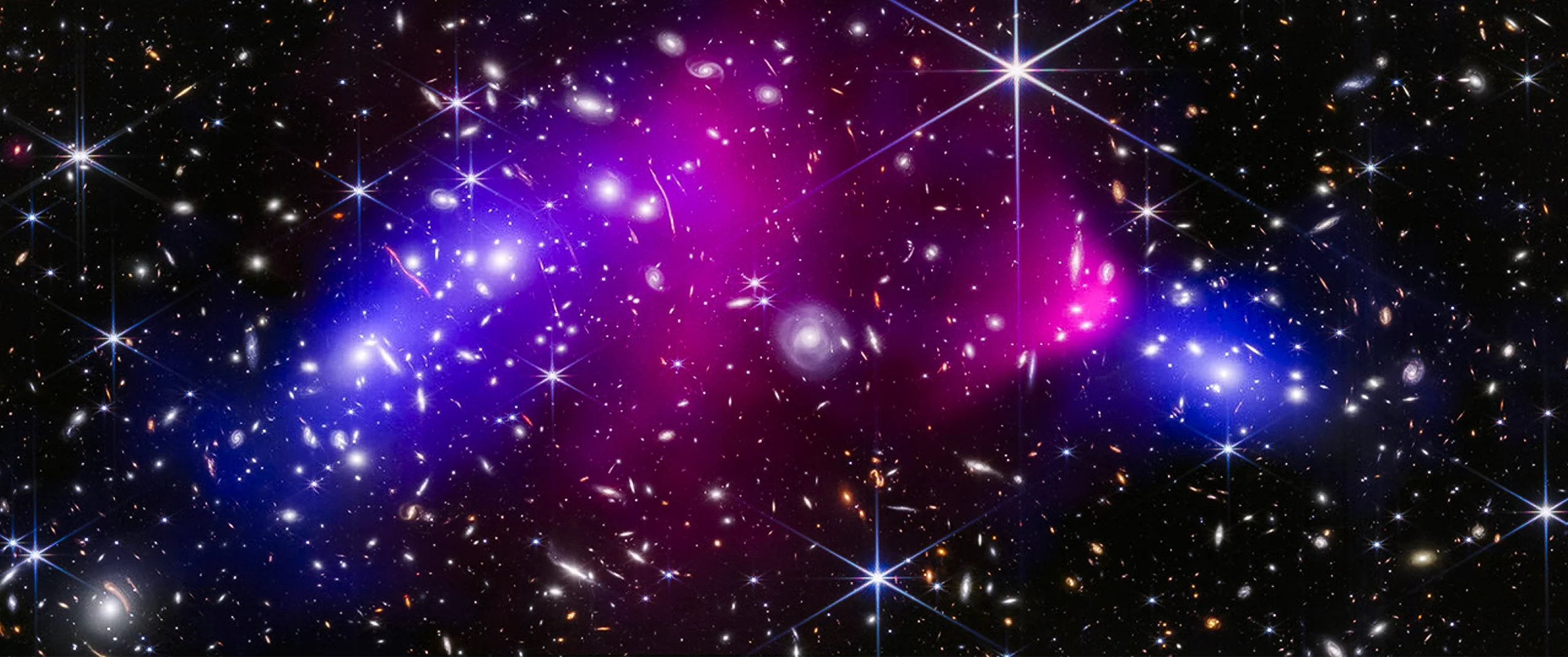
The Bullet Cluster is the result of a massive, ancient collision between two collections of galaxies. In it, intracluster gas (represented in pink) and dark matter (represented in blue) have separated.
NASA
Stacy McGaugh, an astronomer at Case Western Reserve University and a longtime proponent of modified-gravity theories, is more skeptical. “It’s not clear to me what the formation mechanism is,” he said. An ancient collision “is a plausible origin story, albeit an exceptional one. If that’s what’s happened, then the rest follows.” In other words: If these galaxies were created when their dark matter was stolen away, then it makes sense that dark matter is a physical substance.
“But the question is: Is that what happened?” he continued. “And I’m not convinced that that’s the only way that can happen.” Without definitively knowing their origin story, McGaugh doesn’t think it’s possible to say anything about the nature of dark matter itself.
Most experts, though, cannot see how DF2, DF4, and DF9 could exist without dark matter being a physical thing, even if the trio’s genesis can be debated. “It’s hard to explain how you’d get something like this evolving by itself without something like dark matter,” Ghag said.
That makes this galactic trio bad news for MOND, or modified Newtonian dynamics, an alternative to dark matter proposed in 1983 by the physicist Mordehai Milgrom. “MOND says: What if there’s only visible matter, but its gravity works differently than we thought?” Whiteson explained.
MOND implies that, when objects are experiencing a very weak gravitational pull — for example, when two stars are separated by extreme distances — the gravitational force doesn’t dwindle as much as scientists think. That could explain why spinning galaxies can be held together without needing an extra source of gravity from dark matter, its proponents have argued.
Dark matter has long been the favored theory for cosmologists, as MOND “could never really explain everything,” Ghag said. He explained that MOND suffered a significant blow in 2015 when the U.S.-based Laser Interferometer Gravitational-Wave Observatory, or LIGO, detected gravitational waves — ripples in the fabric of the universe — for the first time. Scientists found that these waves move at the speed of light in all directions over huge distances, which implies that gravity works in a consistent, unmodified way throughout the cosmos.
DF2, DF4, and DF9 are also more elegantly explained by dark matter than by attempts to adjust the mechanics of gravity. “It’s easier to remove matter, cold dark matter, through something like a collision, than it is to turn off a law of nature,” Balaji said.
“I think it’s fine and healthy to have alternative theories and open debate,” Whiteson said. “But let’s also be frank about whether the theory fits the data. MOND does not.”
The identity of dark matter still eludes us. But these galaxies are arguably another nail in the coffin of its increasingly unpopular competitor.