Where Did Earth Get Its Oceans? Maybe It Made Them Itself.
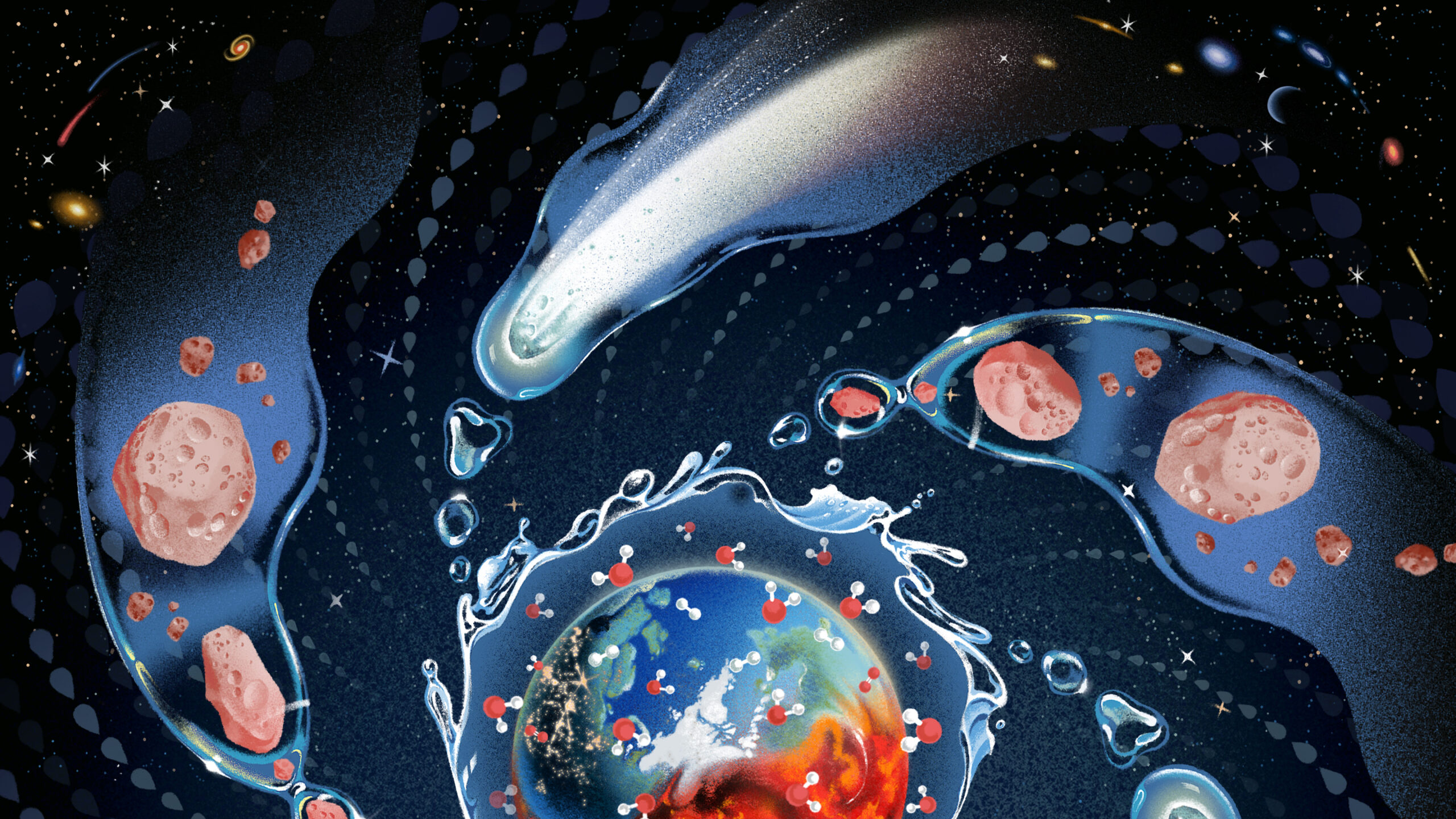
Ada Zejun Shen/Quanta Magazine
Introduction
At this moment, a spacecraft is headed from Earth to Europa, an ice-veiled moon of Jupiter thought to contain an ocean similar in some ways to one of our own. NASA engraved a metal plate affixed to the spacecraft with a poem, commissioned from Ada Limón during her time as poet laureate of the United States. It reads, in part:
And it is not darkness that unites us,
not the cold distance of space, but
the offering of water, each drop of rain,
each rivulet, each pulse, each vein.
For decades, NASA’s exploration of the solar system has been dominated by the search for water in places like Europa, because as far as we know, water is essential for life.
It may come as a surprise, then, that scientists don’t really know how water first arrived here on Earth.
For years, the top theory was that water came to our planet via comets — objects made of frozen matter that orbit the sun, often decorated with sparkling tails. In all likelihood, these icy relics, which came into being at the dawn of the solar system, did bring water with them when they rained down on a primeval Earth. But in recent years, several spacecraft caught up to comets to examine them. What they found was that cometary water didn’t match ours; the chemical signatures were different.
After that, “comets sort of fell out of favor,” said Ashley King, a meteoriticist at the Natural History Museum in London. Asteroids — rockier and more metal-rich than comets — then became the most popular choice. Asteroids impact Earth far more frequently than comets do, and their water reserves (while not as voluminous as those of comets) look a lot more like those on our planet.
But asteroids have their own problems, and a radical new idea about planetary water is gaining steam. Through careful observation of worlds orbiting other stars, along with some explosive laboratory experiments involving diamond anvils and lasers, scientists have realized that rocky planets like Earth have a way to make water all by themselves. All you need is an ocean of magma, a whole lot of hydrogen, and a little bit of geological alchemy.
A Showdown Between Comets and Asteroids
Earth formed about 4.54 billion years ago. Through geologic fire and brimstone, much about its earliest eon has been lost to history, but the basics are agreed upon: It began as a ball of mostly molten rock. Then it became a blue marble. How?
Comets provided a well-motivated answer. They often linger far from Earth in a doughnut-shaped highway of icy objects beyond Neptune called the Kuiper Belt, or in the even more distant and nebulous Oort cloud. But when a comet passes close enough to the sun, its ice and frozen gases turn to vapor, creating a tail that can stretch for hundreds of millions of kilometers (in one known case, more than a billion). Compared to asteroids, comets give you “a lot of bang for your buck,” said James Bryson, a meteoriticist at the University of Oxford.
Scientists thought comets could have crashed to the Earth and provided its water. But nobody could prove that comets contained Earth-like water — until the 1980s, when the European Space Agency (ESA) decided to check. Giotto, their first deep-space mission, was truly ambitious: It would be the first spacecraft to get an up-close-and-personal look at a comet’s icy heart.
In 1986, it caught up to Halley’s comet, famous for appearing in Earth’s sky as our paths intersect roughly every 76 years. Giotto managed to send home both dramatic images of the comet’s nucleus and measurements of the cloud of material around it. What raised scientific eyebrows was Giotto’s measurement of something called the D/H ratio.
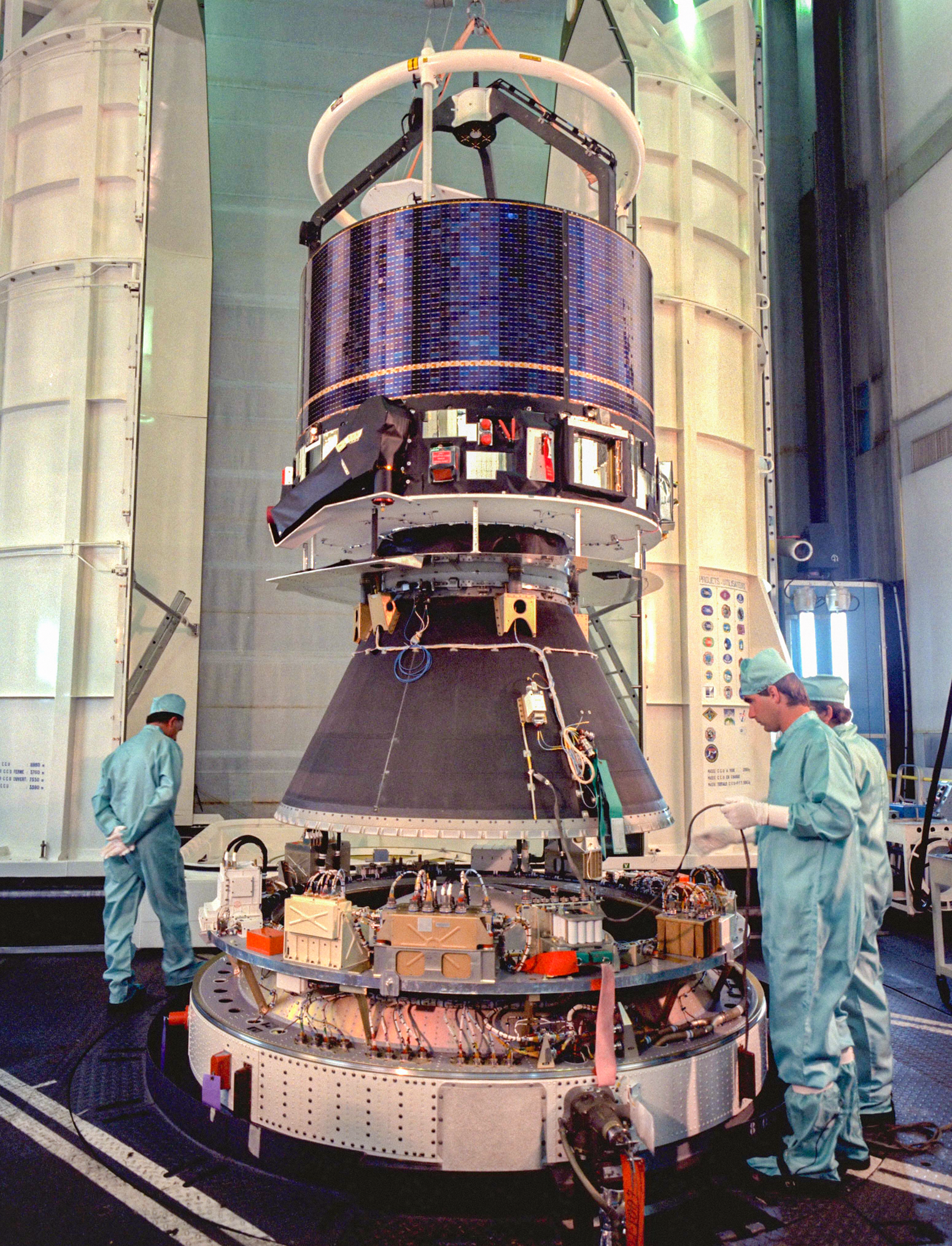
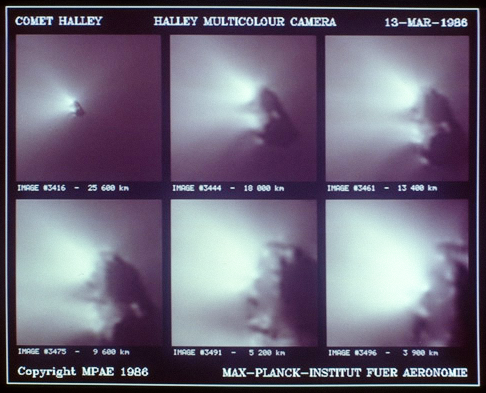
ESA’s Giotto spacecraft (top) took the first close-up images of a cometary nucleus (bottom) as part of its mission to Halley’s comet.
ESA (top); Courtesy of Dr. H.U. Keller
ESA’s Giotto spacecraft (left) took the first close-up images of a cometary nucleus (right) as part of its mission to Halley’s comet.
ESA (left); Courtesy of Dr. H.U. Keller
Almost all the water on Earth is made up of two hydrogen atoms and one oxygen atom: H2O. But there is another form of water, called heavy water, made up of one oxygen atom and two atoms of a heavier form of hydrogen called deuterium.
If comets are responsible for our oceans, one might expect Giotto to have found that the water on Halley’s comet had a similar ratio of deuterium to hydrogen as the water on Earth. That’s not what it found. “It didn’t match at all,” said Karen Meech, a planetary astronomer at the University of Hawai‘i. In fact, Halley’s D/H ratio was twice that of most of the water on Earth.
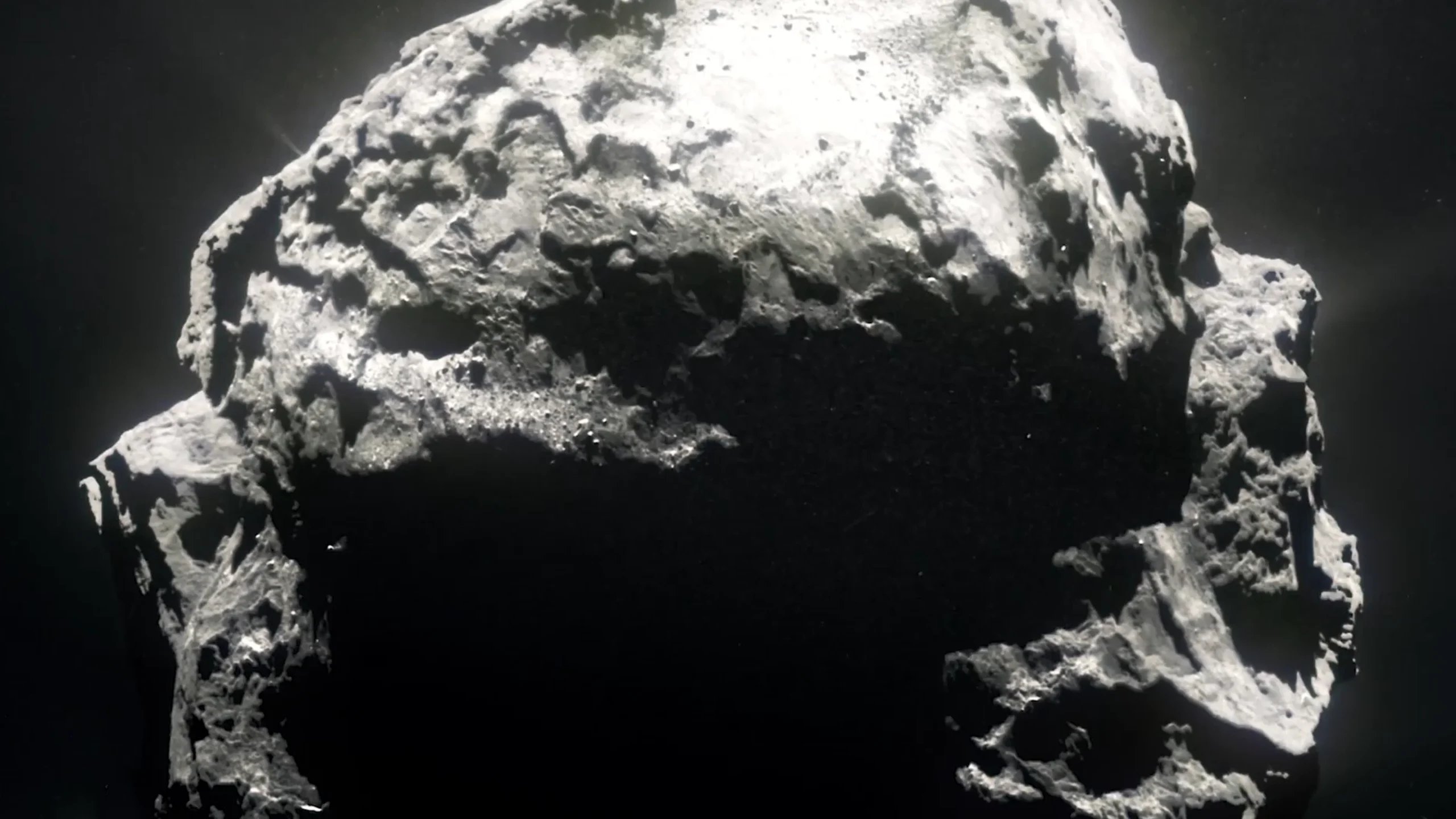
More cracks appeared in the comet theory during the 1990s and 2000s, when spectroscopic observations of other comets, like Hale-Bopp, also found evidence of heavy water. But the hammer blow arrived in 2014 when the spiritual successor to Giotto, ESA’s Rosetta mission, made history by orbiting and sending a lander to the surface of 67P/Churyumov-Gerasimenko, a comet shaped like a giant rubber duck. During its orbits of 67P, Rosetta made the most precise measurements of a comet’s composition to date — and found that it contained the highest concentration of deuterium of any comet we’ve measured.
If Earth’s water didn’t come from comets, perhaps it came from asteroids. These rocky objects mostly hang out between Mars and Jupiter, and they impact our planet all the time as meteorites, though most of their material burns up in the atmosphere or lands in the ocean. Scientists have collected tens of thousands of meteorites and found that the water molecules contained in a particular group closely resemble those in our world. One meteor that plunged into the sleepy British town of Winchcombe in 2021 — leaving a sizable dent in a family’s driveway — was found to have a D/H ratio that almost perfectly matched that of Earth’s oceans.
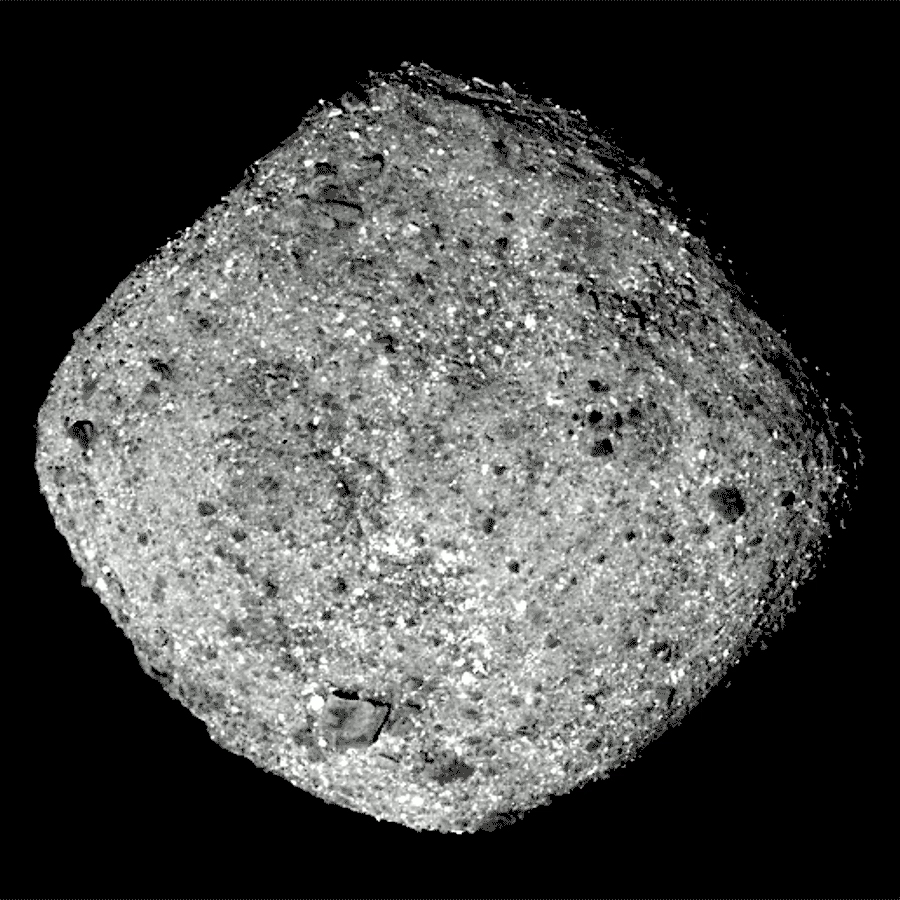
Meteorites, though, can be contaminated during their fiery dives and crash landings. That’s why scientists have flown spacecraft out to asteroids and collected material in orbit for forensic analysis. In some cases, they have found that asteroids still moving through space also seem to have Earth-like water. A study published in 2023 revealed that water from the asteroid Ryugu, which Japan’s space agency visited in 2018, had a D/H ratio similar to that of most water on Earth. When it comes to the provenance of Earth’s water, “the community is probably more favorable of asteroids than comets these days,” King said.
But the D/H ratios of asteroids did not close the book on the question of Earth’s water. Asteroids also contain small amounts of noble gases like argon, krypton, and xenon — inert elements that act as tracers of various geologic processes — and scientists have found that those mixtures do not usually correspond to what we find on our planet. In addition, theories based on comets and asteroids have the same fundamental problem: The ability of either type of object to give the planet its oceans relies on luck. Multiple asteroids or comets would have had to impact Earth after its superhot magma ocean phase to produce the inundated world we live on today. This was taken for granted in the past, but the existence of this late-in-the-day bombardment is heavily debated in the scientific community.
There is another possibility, one that relies not on cosmic chance, but on our planet’s own industriousness: Earth made most of its water by itself.
Hydrogen, Meet Magma
When astronomers look at exoplanets — worlds outside our solar system — they see a diversity of atmospheres. But when they simulate the ways the planets took shape, scientists find that many of them could have started out brimming with hydrogen. Could Earth’s formative years have been similar?
Scientists used to think that the early Earth had little hydrogen. They reached this conclusion after examining meteorites called enstatite chondrites that have a suspiciously similar chemical makeup to Earth. Because of this similarity, scientists think the two probably formed from the same material, Bryson said. These meteorites seemed to lack hydrogen, so scientists thought the same went for our planet.
But some studies, including one co-authored by Bryson, found that there was hydrogen in the meteorites all along. It was just hidden in their organic molecules, silicate glasses, and sulfur compounds. Perhaps, then, Earth was also awash in hydrogen in its early days.
Earth’s ocean of magma was full of oxygen. In a paper published in 2023, three scientists wondered what might happen if the hydrogen in a planet’s atmosphere and the oxygen in its magma were to mix — somehow. Hydrogen doesn’t just spontaneously bind to oxygen, so they aren’t the most willing chemical partners. Still, the researchers concluded that such a process would let a planet make its own water; they just weren’t sure how much.
Two years later, they were thrown a lifeline by an ambitious set of experiments built by the researchers Harrison Horn, a physicist at Lawrence Livermore National Laboratory; S.-H. Dan Shim, a geophysicist at Arizona State University; and others.
Among other things, they wanted to know how sub-Neptunes, commonplace exoplanets two to four times the diameter of Earth, can have atmospheres rich in water, as telescopic observations suggest, even when they hew close to their scorching-hot host stars. Could a reaction between a hydrogen atmosphere and a magma ocean be enough?
They suspected it could, but only if a huge amount of hydrogen put the magma under a sufficient amount of pressure. “That higher pressure is a big part of what facilitates the water production,” Horn said. “It actually enhances the chemical reactions.”
To test their model, the team wanted to re-create the extreme (and extremely dangerous) conditions present on adolescent sub-Neptunes. They needed to put hydrogen, a highly flammable gas, under intense pressure using special tools called diamond anvils, and then combine it with rock samples melted with lasers. It took them five years to develop the techniques they needed to conduct these experiments safely and effectively. “We broke a lot of diamonds,” Shim said. “It was an exciting journey.”
They had hoped the hydrogen and oxygen would react to make water. And that’s what happened, to the extreme: The reaction of high-pressure hydrogen and laser-melted rock was so efficient that it made up to 1,000 times more water than scientists predicted. (A second laboratory study, published around the same time, reported similar results.) “It doesn’t seem unreasonable [that you could] produce a huge amount of water quite quickly,” said Paul Byrne, a planetary scientist at Washington University in St. Louis. And “this is all homegrown, indigenous water”— no comets or asteroids required.
Does that mean Earth created its own oceans? This is where the waters get a little murky. “The paper doesn’t make strong claims about Earth,” Horn said. But both he and Shim think it’s a valid link to make. “It could happen,” Shim said.
Other scientists agree that some amount of water could have formed on Earth — but perhaps not nearly enough to produce its oceans. “I’d say it’s certainly possible that some water could be generated by reaction with hydrogen early on,” said Quentin Williams, an experimental geophysicist at the University of California, Santa Cruz. “How much might be generated is, however, pretty enigmatic.”
The issue is that nobody knows if there was enough hydrogen in Earth’s early atmosphere to create the pressure the reaction seems to need. Sub-Neptunes are far more massive than Earth, and their intense gravity is better at holding on to hydrogen. “Earth is right on the edge of where that kind of thing can start happening,” Horn said.
Some scientists don’t think Earth had the heft to manufacture its own water at scale. “I’m a little bit doubtful whether you can have this for an Earth-mass planet,” said Anders Johansen, an astrophysicist at the University of Copenhagen in Denmark and at Lund University in Sweden. But, Byrne said, the sub-Neptune experiments suggest that the reaction wouldn’t need to last long to create an enormous quantity of water. Earth might have been a water factory for only a moment, but that moment may have been enough to forge oceans.
If that’s the case, then the implications stretch far beyond our own solar system. Perhaps countless planets meet what may be a necessary condition for hosting life because, as Byrne said, they “are born water-rich.”
Drowning in a Sea of Possibilities
It’s possible that at least some of Earth’s water came from processes on the planet. But that’s not the end of the story: Comets are making a comeback.
By the time Rosetta met the duck-shaped comet 67P in 2014, scientists had studied the water of 11 other comets. All had D/H ratios unlike Earth’s — except one. In 2011, ESA’s Herschel Space Observatory found that the water in the comet Hartley 2 had a much more Earth-like signature.

The observation seemed anomalous. But in a paper published in 2024, scientists reinvestigated Rosetta’s analysis of comet 67P — and found that space may have tampered with the data. At the time of the sample collection, Rosetta had been flying through dust that contained heavy water. The icy comet body itself, surrounded by this dust, may have been fairly Earth-like after all. Then, in a paper published in 2025, observations of comet 12P/Pons-Brooks detected a D/H ratio much like that of Earth’s oceans.
So, was it comets all along? Or asteroids? Or did Earth turn on the taps independently? “I suspect it was a combination of all of them,” Meech said. Perhaps it’s hard to find a perfect extraterrestrial match for our planet’s watery chemistry because it’s such a diverse cocktail — one that’s also been tweaked and filtered over time by Earth’s geologic, atmospheric, and biologic processes. “We may never know,” Meech said.
But that doesn’t mean scientists will stop trying to answer one of the most fundamental questions about Earth and, ultimately, our own existence. “It’s like asking, what’s the origin of life?” Meech said. “The more you learn, the less you know — but the story becomes richer and more exciting.”