Where Some See Strings, She Sees a Space-Time Made of Fractals

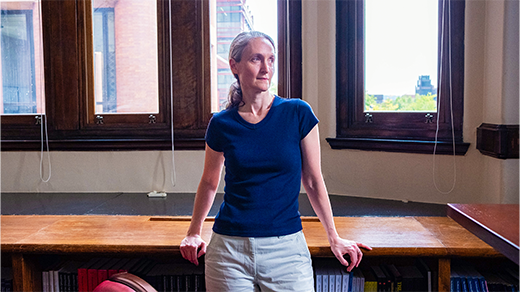
Astrid Eichhorn, a physicist at Heidelberg University in Germany, is a leader in the field of asymptotic safety — a conservative theory of quantum gravity.
Konrad Gös for Quanta Magazine
Introduction
Astrid Eichhorn spends her days thinking about how the laws of physics change at the tiniest scales.
Imagine zooming in closer and closer to the device on which you’re reading this article. Its apparently smooth screen quickly dissolves into a jiggling lattice of molecules, which in turn resolve into clouds of electrons buzzing around atomic nuclei. You dive into a nucleus, and atoms disappear as you enter the domain of quarks. It is here, where protons loom as large as solar systems, that Eichhorn’s explorations begin.
Past this point, the fundamental forces themselves shift. Electromagnetism and the weak interaction intensify, while the strong force slackens. The changes happen in a fairly regular way, so physicists have a good sense of how they work … until they don’t.
When an atom appears as large as the observable universe, the established laws of physics can no longer tell you what happens between particles separated by an atom’s width. Gravity, a force that’s too weak to notice at the scale of atoms, grows strong in an erratic way. You’ve just crossed over into the “Planck” realm.
The apparent breakdown of particle physics at this scale has inspired some dramatic theories. Some physicists argue that this failure point in our understanding tells us that the universe is fundamentally composed not of particles, but of vibrating strings and membranes. Others argue that at these smallest scales, space and time themselves must dissolve into structures such as loops.
Eichhorn and her colleagues are pursuing a different possibility. In 1976, Steven Weinberg, a theorist who would eventually earn a Nobel Prize, pointed out that if you zoomed in far enough, you might reach a place where the rules of physics would stop changing. New realms would stop appearing; the intensities of the forces would stabilize; and gravity would turn out to make perfect sense after all.
Eichhorn, a physicist at Heidelberg University in Germany, has over the last decade become a leading theorist investigating this idea, called asymptotic safety. In particular, Eichhorn has emphasized the importance of taking into account the ways in which matter affects space-time, and vice versa. “She is the expert of gravity-matter systems in asymptotic safety,” said Alessia Platania, a physicist at the University of Copenhagen who has worked with Eichhorn.

The quantum fields in nature have ripples that balance in just the right way to stabilize the laws of physics at shorter scales, Eichhorn’s work has suggested.
Konrad Gös for Quanta Magazine
Over the last decade, Eichhorn has made significant strides toward showing that the quantum laws likely do stop changing around the Planck scale, just as Weinberg suspected. She has also connected Planck-scale physics with physics at scales that are easier to study — a famously challenging task for anyone working with a theory of gravity at the smallest levels. Quanta recently spoke with Eichhorn about these efforts. The interview has been condensed and edited for clarity.
What’s the big problem? If we treat gravity like the other forces at the smallest scales, what goes wrong?
So, the approach we use with most of the forces is called quantum field theory. It assumes the universe is full of quantum fields. Fields have ripples that manifest as pointlike particles. These particles move through a continuous space-time and interact via forces.
Ultimately the problem is that if we try to treat quantum gravity as a fluctuating quantum field in this most straightforward way, then this approach does not work.
Very roughly, for a well-understood force like electromagnetism, we need to consider fluctuations in the field at all scales. And these fluctuations never stop coming as you zoom in. They act like virtual particles with higher and higher energies. We know how to account for the effects of these high-energy virtual particles in our calculations: The intensity of the force changes, but that’s it.
But when you try to add gravity, which Albert Einstein linked with the structure of space-time, the fluctuations become problematic. At shorter distances, the higher-energy virtual particles interact in new and different ways. We can’t account for these ever-changing effects, so quantum field theory fails to predict what will happen at those tiny scales.
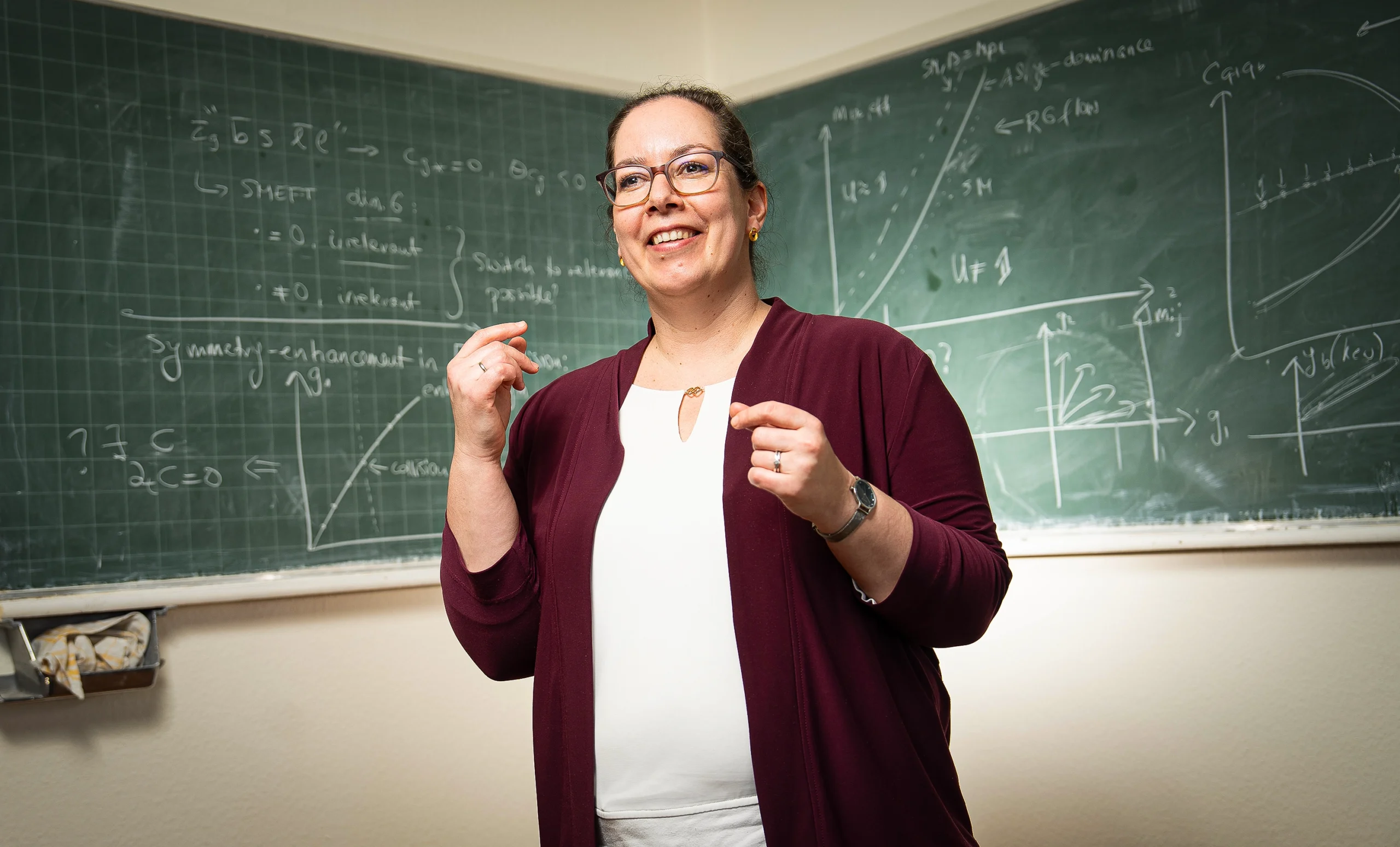
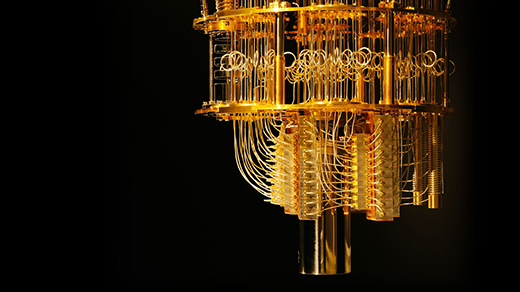
Physicists use the machinery of renormalization, which Eichhorn describes as a “mathematical microscope,” to calculate how the world changes as you zoom in and out.
Konrad Gös for Quanta Magazine
What do physicists think this failure of quantum field theory is telling us?
It tells us that something new happens as we zoom in. And I would say there are roughly three lines of thinking as to what that might be.
One is that maybe quantum field theory breaks down, full stop. The objects are not points, in the way that we think of elementary particles as points. Instead, they become stringy. That’s string theory.
Another is that we need to remove the assumption that space-time is continuous. I take my glass of water, and it looks continuous to me, but fundamentally it’s atomic. Maybe it’s the same with space-time. This is the idea spelled out in loop quantum gravity, or in causal sets.
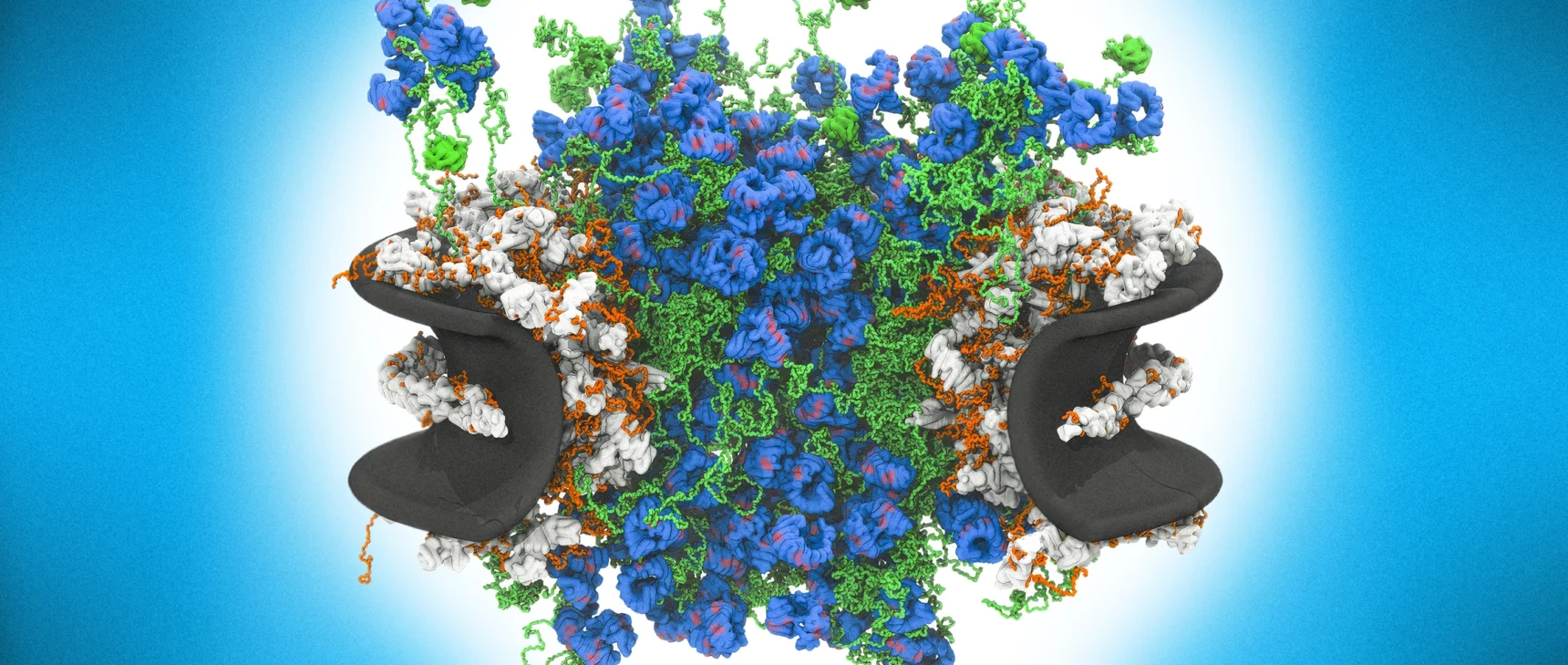
Or you can say that fields and particles persist; space-time persists; and the new thing is that space-time takes on a structure that is, broadly speaking, like a fractal: The intensity of the forces, including gravity, stops changing, and you start seeing the same picture, the same rules for how particles talk to each other, over and over. That’s the idea I’m pursuing, asymptotic safety. If this self-similar realm exists, then the fluctuations of space-time, and of the other fields, would become stable enough for us to make predictions using good old-fashioned quantum field theory.
A fractal-like space-time sounds cool, but it also sounds pretty out there. Why is this a sensible thing to expect?
One reason is that symmetries are very common in many theories of nature. Space-time itself has symmetries, for instance. There are no special directions, no special places, and no special times. But we do have special scales: The world looks one way to humans, another way to bacteria, and yet another way to electrons. That’s peculiar. So I think it’s a natural assumption to say that at the fundamental level, maybe there are no special scales. Maybe there is a symmetry between scales, a scale symmetry.

Eichhorn also studies the ways in which asymptotic safety could be compatible with the picture of reality emerging from other approaches to quantum gravity, like string theory.
Konrad Gös for Quanta Magazine
Another is that this is a very conservative approach to quantum gravity. You take quantum field theory, which has never failed in the lab, and you ask: What do you need to do to make it predictive for all scales? And as far as we know, adding scale symmetry is the only thing we can do.
How can you test this idea?
First we need to check whether quantum fields can actually fluctuate in such a way that they achieve a special balance between them that makes all scales look the same. We work with a procedure that is sort of the mathematical version of a microscope: We set up a mathematical representation of the fields and their interactions, and we calculate how the interactions between the ripples in the fields change as we zoom in. Then we look for a place where that change stops, a place we call a fixed point.
Have you found any?
We have tons of simplified examples of idealized theories with fixed points. The community at large has worked a lot on empty space-time, just pure gravity. Actually, most of us work in an even more simplified setting where there are only quantum fluctuations of space, rather than fluctuations of both space and time. But nevertheless, people have tested this in literally hundreds of papers and found very robustly that this fixed point where things stop changing exists.
And then the next question to ask is: What happens when I throw in matter fields? This is one of my earliest papers that I wrote as a postdoc in 2013. My collaborators and I included all the known matter and force fields and found that the fixed point was still there, albeit in this funny space-only setting. We gave the paper this catchy title, “Matter Matters,” and it became a bit of a slogan for me.
Last summer we tied things up by showing that there is likely a fixed point even when we include all of the ways that the known fields can interact with each other — something we left out of the 2013 paper. We have now looked at the complete picture for the first time.

Eichhorn and her collaborators make predictions by assuming scale symmetry and asking what kind of a world they will see when they zoom back out to our level.
Konrad Gös for Quanta Magazine
So far, this sounds like mainly a math question. Where does the physics come in? How can you test whether our universe really works this way?
To test it, we turn the logic around. Instead of zooming in and looking for mathematical evidence of a fixed point in our models, we assume that a fixed point exists and zoom out, asking: What physical implications would a fractal-like realm have for our macroscopic world?
And what implications would it have?
We have good indications that it would force the macroscopic world to look a lot like the world we see. In 2009, Mikhail Shaposhnikov and Christof Wetterich showed that zooming out from a fixed point forces the mass of the Higgs boson, the particle that accounts for mass, to be almost exactly the value we measure.
And in 2018, my Ph.D. student Aaron Held and I had a memorable moment. The previous year, we had already found that a fixed point would force the top quark to have close to the measured mass. And we were investigating whether it could also account for the mass of the top quark’s sibling, the bottom quark. They’re supposed to be identical twins in the eyes of gravity, because their distinctive quantum properties are not things that gravity is sensitive to, but experiments have found that they have different masses.
I remember this afternoon distinctly. Aaron and I sat together in my office in front of my laptop, and we were looking at plots of our results in the software Mathematica. We saw that indeed there is this point where the predictions match up to within 10%.
In a world with no fixed point, the masses could be anything. But if there is a fixed point, a very particular conversation starts up between gravity and the electroweak force, and a result of that conversation is that these quarks basically have to have the two different masses that they do.
To this day we call it the OMG plot. It was just so mind-blowing to us that this idea really works out in a quantitative way.

If the world is fundamentally “scale symmetric,” Eichhorn says, then the textbook quantum theory may perfectly capture the behavior of gravity and the structure of space-time.
Konrad Gös for Quanta Magazine
Can you predict all particle properties from the existence of a fixed point?
We’ve made more progress since 2017. We were able to connect the fixed point with a few neutrino properties, including their weirdly light mass, which we found simultaneously with another group.
But we also know that asymptotic safety is quite far from explaining everything. The real proton mass is consistent with a fixed point, for instance, but it could also be 10 or 100 times as heavy.
As far as we can tell, though, there are no particle properties that are incompatible with asymptotic safety. If there were, we could rule the theory out. But for now, everything works, and it looks like we might explain a little bit more about the properties of particles and their interactions than we could before. That might be progress. That makes me happy.
If someone had done this work in the 1980s, before anyone had measured the mass of the top quark, what do you think the quantum gravity landscape would look like today?
We’ve made these “retrodictions,” and that’s nice. But sometimes I think, “Man, we were too late!” If someone had made these as actual predictions back then, maybe asymptotic safety would be the largely established view of quantum gravity.
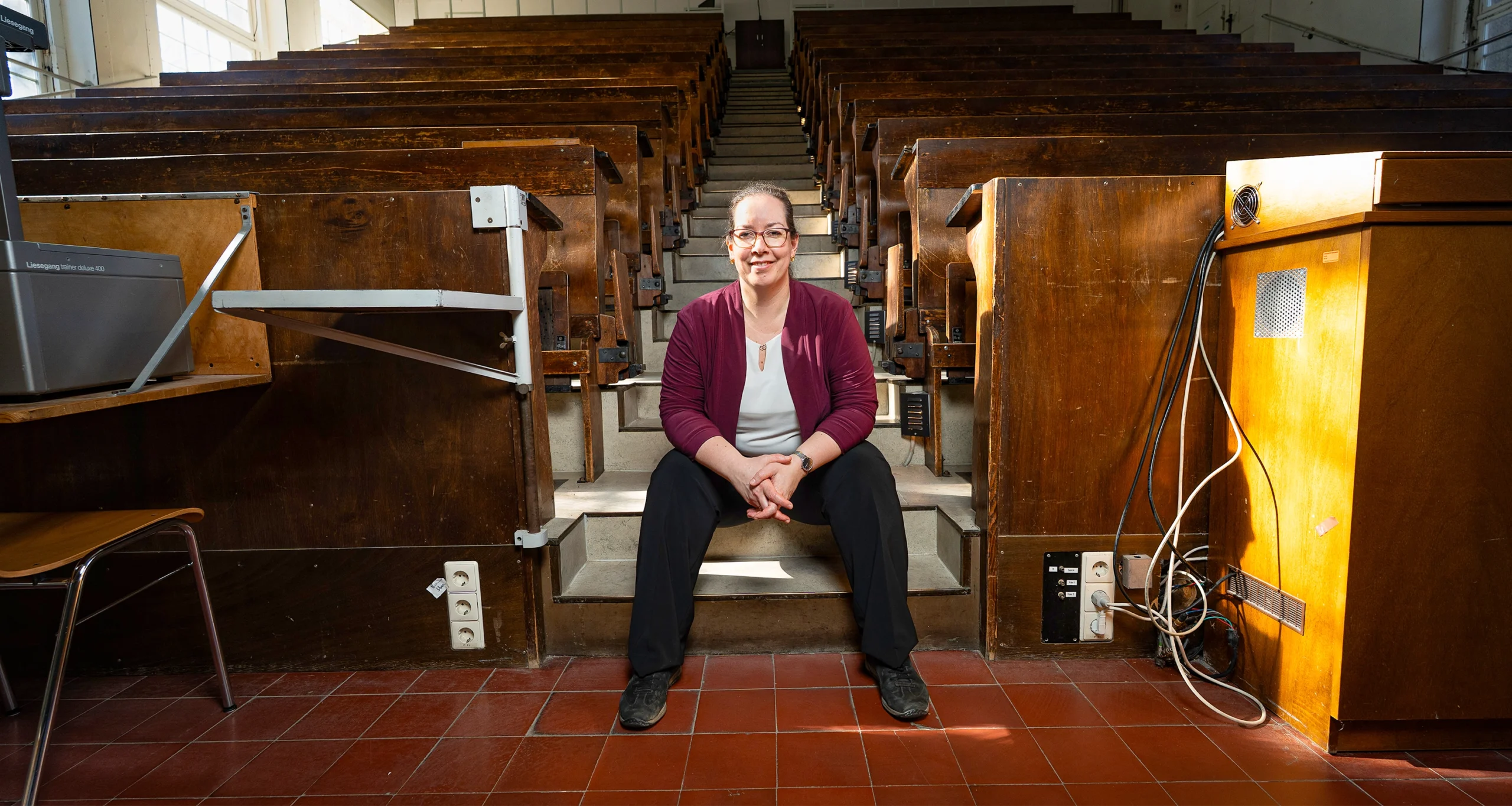
Eichhorn suspects that if you zoom in far enough, the laws of physics may stop changing.
Konrad Gös for Quanta Magazine
Or maybe they would have advanced beyond where we are now and found a point where asymptotic safety doesn’t work out. Then they might have abandoned it for strings and other exotic theories with a complete confidence that such a drastic move is necessary.
Well, are there any bona fide predictions you can make about unknown particles?
We’ve looked at various proposals for dark matter, and I can tell you a number of things that probably don’t work in asymptotic safety.
Like what?
Several of the popular dark matter models, actually. The simplest versions of weakly interacting massive particles, for instance; the simplest type of axionlike particles most people look for; and the kind of ultralight dark matter that could influence upcoming nuclear clocks all don’t seem to be compatible with the fractal world, although we cannot exclude them with absolute certainty.
So do you think hunters looking for WIMPs, axions, and ultralight dark matter are all wasting their time?
Definitely not! Experimentalists are bravely going forward and testing as much as they can. And those tests can be seen as tests of asymptotic safety. If an axion experiment finds dark matter tomorrow, that would actually put our theory under pressure. So these hunts are indirectly informing us about the quantum structure of space-time, and I find that a rather cool by-product of these experiments.
If you could predict a specific dark matter candidate someday and then someone found it, what would that mean for the other theories of quantum gravity?
You might think it would rule them out, but this is not necessarily the case. Asymptotic safety could be compatible with these other approaches. Perhaps at the fundamental scale there are strings or loops or something, but then as you zoom out you hit a realm where things change so slowly for a while that it looks as if you’re at a fixed point. That’s possible, and it means that distinct quantum gravity approaches may actually not be competitors, but rather different perspectives on the same physics.
It sounds like one should be humble about any picture of space-time.
In quantum gravity research, it’s always a good idea to be humble.