How Do Fungi Keep the Planet Healthy?
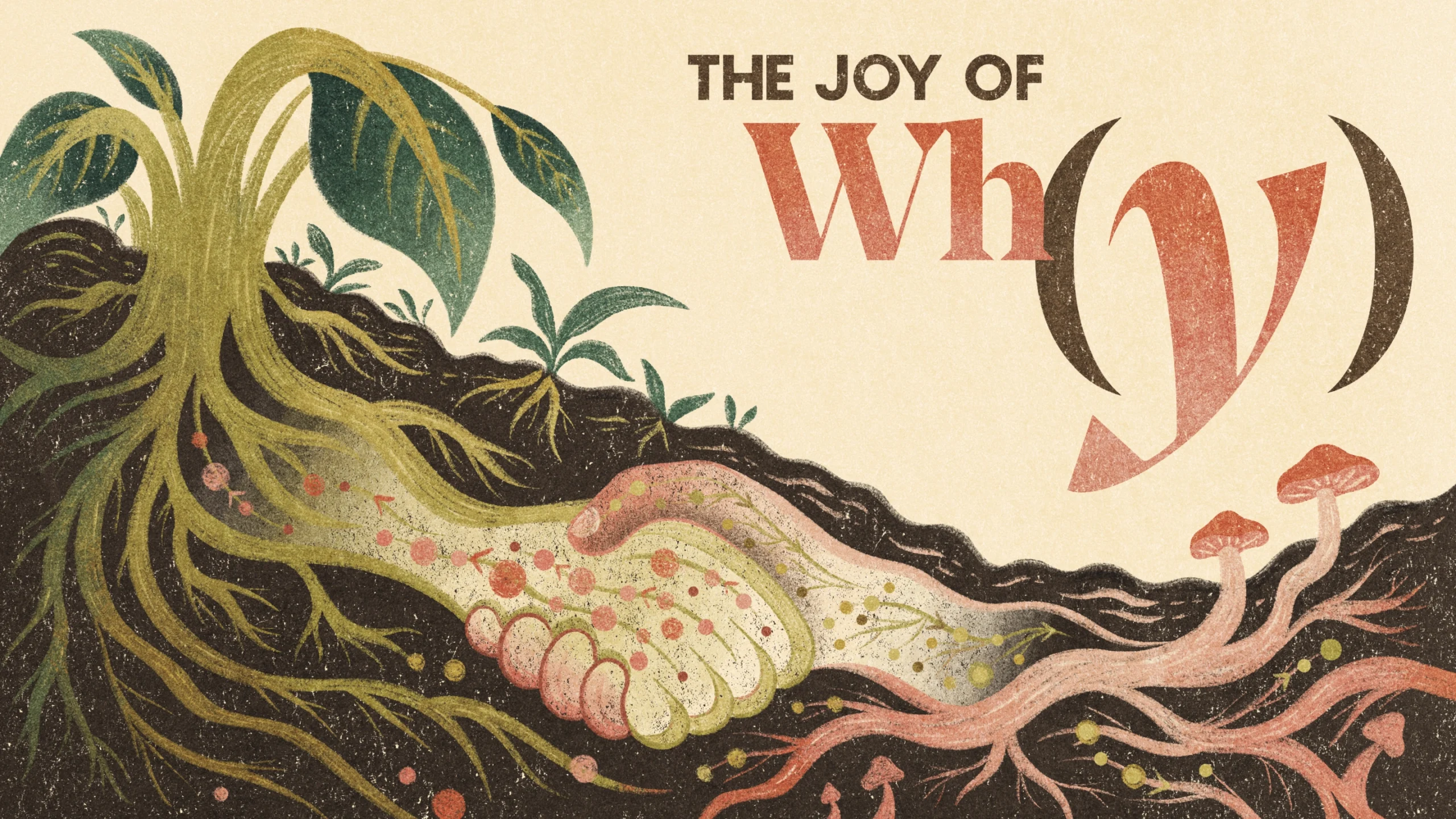
Chanelle Nibbelink for Quanta Magazine
Introduction
People may think of soil as just dirt, but it is anything but inert. Beneath your feet, a vast network of mycorrhizal fungi is hard at work, trading minerals with plant roots. This trading system helps enrich the soil, and it sequesters 13 billion tons of atmospheric carbon dioxide each year — roughly equivalent to one-third of the world’s fossil-fuel emissions. Scientists know that these fungi form partnerships with 80% of all plant species on Earth, a relationship that evolved some 450 million years ago. What they have not understood is how organisms with no brain or central nervous system can decide whom to trade with, and on what terms.
Toby Kiers, an evolutionary biologist at Vrije Universiteit Amsterdam, has spent much of her career making this hidden world visible. Drawing on economics and game theory, and using tools that range from fluorescent quantum dots to imaging robots, her lab is probing how fungi and plants conduct their trade. The work raises new questions about soil, carbon, and even what counts as an individual organism. In this episode, Kiers tells co-host Steven Strogatz how these brainless, decentralized organisms can behave strategically — discriminating between better and worse partners and shifting resources across the network to wherever a plant will “pay” more for it — and how she has built a worldwide community of researchers to map the biodiversity of these underground networks and advocate for their protection.
Listen on Apple Podcasts, Spotify, TuneIn or your favorite podcasting app, or you can stream it from Quanta.
Transcript
[Music plays]
STEVE STROGATZ: I’m Steve Strogatz.
JANNA LEVIN: And I’m Janna Levin.
STROGATZ: And this is The Joy of Why.
LEVIN: A podcast from Quanta Magazine where we explore some of the biggest unanswered questions in math and science today.
STROGATZ: Hey there, Janna. I would love to talk to you about a big question.
LEVIN: Okay.
STROGATZ: Imagine you’re walking around in the forest or in Central Park.
LEVIN: That’s my forest!
STROGATZ: I know, so what’s under your feet? What are your shoes hitting?
LEVIN: I think people would be very surprised that there’s real nature in Central Park. So you got the grass, you got the trees. Uh, there’s dirt. We have birds.
STROGATZ: Let’s focus on the dirt.
LEVIN: Is dirt our topic today?
STROGATZ: Dirt is related to our topic. We wanna talk about what’s happening underground in the form of what are called mycorrhizal fungi. I learned that I’m supposed to say fun-gee.
LEVIN: Not fun-guy?
STROGATZ: Not fun-guy.
LEVIN: I say fun- fung- fun-guy.
STROGATZ: Well, what would I say? I would probably s- I don’t know. Fun-ji?
LEVIN: So now I have to say fun-gee?
STROGATZ: You’re supposed to say fun-gee for the purpose of this episode.
LEVIN: Is that like saying Uranus?
STROGATZ: [Laughs] You should be saying that.
LEVIN: I do yeah.
STROGATZ: Well, so I spoke to someone recently that changed my perspective about these fungi under our feet and the wood wide web. Not the worldwide web, the wood wide web. It’s the mycorrhizal network of these vast networks of fungi that we never notice that are underground, and they’re incredibly important in connecting the roots and supplying nutrients to trees and other plants. Something like 80% to 90% of all the plant species all over the world are getting help from these fungi.
They’re also helping our atmosphere and our climate. They enrich the soil to help farmers and biodiversity, agriculture. They may even contribute to cloud formation through the release of their spores over rainforests.
LEVIN: Wow.
STROGATZ: So they may not get much respect, the fungi, but they’re right up there with the animals and plants in mattering to the world.
LEVIN: Yeah, ’cause you always hear about the role of bacteria, and so it’s really interesting how fungi could affect the whole ecosystem like that.
STROGATZ: Well, the bacteria are very intimately associated with these fungi. and That’s something that we’re going to hear from our guest about.
LEVIN: Alright.
STROGATZ: Toby Kiers is her name. She is an evolutionary biologist at the Vrije University in Amsterdam, and a recent MacArthur Fellow. So if you’re ready, here we go.
[Music plays]
STROGATZ: Welcome to The Joy of Why, Toby.
TOBY KIERS: Thanks so much about having me.
STROGATZ: Well, this is an area that is not familiar to me at all, and I’m dying to hear about it. Can you describe what your subject area is first, just in very broad terms?
KIERS: I study the class of organisms called mycorrhizal fungi, and the word mycorrhizal means myco, which means fungus, and rhizal, which means root. So these are a class of fungi that form a very intimate association with the vast majority of plants. So over 80% of all plant species on Earth form these partnerships, and it’s a very old partnership.
It evolved some 450 million years ago, and was actually really fundamental for plants that were in a wet, aquatic environment to start colonizing land hundreds of millions of years ago. And since then, it’s been an incredibly important relationship in building ecosystems that we live and survive on today.
And I don’t think many people know, but actually the fungus served as a plant root system for even tens of millions of years. Roots are kind of a new evolutionary innovation, so it’s a very intimate and old partnership between plants and fungi.
STROGATZ: So you’re saying the plants didn’t go to the bother of making their own roots? They were somehow using the fungi to do that for them?
KIERS: Exactly. So, what the plants were doing was they were sending carbon that they were photosynthesizing and taking out of the atmosphere and feeding it to these loose associations, these fungal networks that were in the soil, and in return they were getting resources like phosphorus and nitrogen. See, the thing that fungi are very good at is breaking up rocks and digesting these hard-to-access minerals.
And so they were feeding it to the plants, and in return the plants were giving carbon. And now this partnership really underlies our ecosystems on Earth.
STROGATZ: Oh, wow. I have all kinds of questions. First of all, very dramatic to say breaking up rocks. I don’t, just haven’t thought about it. What are they doing to break up rocks?
KIERS: Well, the fungi make these beautiful complex networks, and fungi are very good at digesting outside of their bodies and actually partnering with other microbes like bacteria that can help break down rocks. So, some people even say they’re very good at eating rocks on the outside of their bodies and having it dissolve into a form that can then be taken up.
And so the fungi then take up these nutrients and move them through these vast networks and feed them to plant roots. And in return —obviously they don’t do this for free — the plants are feeding them a diet of sugar and lipids like fats. It’s like the most brilliant diet of sugar and fats that is provided by the plants to the fungi. And this partnership is very common. It’s almost ubiquitous, I would say, across terrestrial ecosystems. And because of this partnership and because plants are constantly feeding carbon down to these networks, we actually call it one of Earth’s circulatory systems.
STROGATZ: Oh, nice. So, network is a word that everybody is using these days. We hear about the internet. We know we have our own circulatory system in our body, networks of blood vessels. But so when you talk about a mycorrhizal fungal network, what should I picture?
KIERS: Exactly. And it’s very clear. One thing I really want people to understand is that plants are not fungi , and fungi are not plants, and they’re very different kingdoms of life. So when you have a plant root and you were to pull it up from the ground, that’s a beautiful image, you would not quite be able to see these threads that are hanging from the root. They’re thinner than the hairs on my head, just a few microns across.
And the type that we really concentrate on are called arbuscular mycorrhizal fungi, and we can get into where that name comes from. But these particular networks are like an open-pipe system. They’re literally like a tube. And in some senses, people think they’re the largest cells on Earth because they don’t have the septa that break it up into individual compartments.
And so a lot of what we do in the lab is growing these networks across sort of a transparent soil almost, like a way that you can see the networks and use microscopy to follow these networks and understand how they navigate space. We have developed together with biophysicists at the Biophysics Institute called AMOLF here in Amsterdam, these imaging robots that allow us to track individual nodes across these networks. So in any given experiment, we’re tracking about half a million of these nodes, these fungal decisions whether to go left or right or make a bridge when they fuse together.
And they actually make a beautiful supply chain because what you’re imagining —and I want you to really close your eyes and picture this — is that the plant is pouring carbon down into this root system, and the carbon, which now we can label with a fluorescent label, so we can actually watch it travel through this open-pipe system all the way down to the tips where the fungi use the carbon to keep building their network. Now, as they’re building that network, they’re collecting the phosphorus and the nitrogen in the water that they’re moving in an opposite direction back to the root system. Now, one of the most fascinating things about this symbiosis is that this is an open-pipe system, yet it has flows moving in two directions at the same time.
So it’s like a river going north and south at the same time. So when you say picture it, it’s actually one of the most beautiful things I’ve ever seen. And the biophysicists when they saw it for the first time, they said, “ This just can’t be true. How do they do it?”
STROGATZ: This is amazing. This is off topic, but I’m just gonna throw it out there but when I was a kid in high school, I had a science teacher who showed me how to do an experiment that Galileo had described in the 1600s, where Galileo said he took a little jug of water and another jug of wine, and then he could connect these two reservoirs, the wine on the bottom and the water on the top. And there’s this thin vertical tube connecting them. Galileo said that the wine will rise through the tube and the water will flow down through the tube, and they will pass through without mixing and they will trade places. And I actually did this experiment.
KIERS: Did it work?
STROGATZ: And it worked. They didn’t mix in the tube. My teacher took a photograph of it. It was published in a history of science magazine when I was 13 years old. The, the point being that a historian of science said Galileo was fudging and he had made up this experiment because we all know that when two things pass through the same tube, they would mix.
You’re telling me a story about two different flows through a whole network of tubes.
KIERS: Exactly, exactly.
STROGATZ: Am I on the right track thinking like this?
KIERS: You are kind of on the right track, and it’s something that is a big open question in our lab right now, so it’s something we’re constantly thinking about. I think I go to bed thinking about it and wake up thinking about it. But what you have to remember is that the diet that the plants give the fungi is full of fat, and fat doesn’t mix very well with water.
And so there are these things called condensates, which are these big lipid droplets inside the network. And what we think is happening is that there’s these beautiful molecular motors that are inside the network that actually drag the lipids, the fats, to the tip of the network so the fungus can use it to grow. And we think that’s what’s happening, is that when you pull these lipids on these… So a molecular motor, you can think of it as, a little railroad track that has, one of those cars on it that people move up and down and up and down to move forward. That’s what a, a molecular motor looks like.
STROGATZ: Uh-huh.
KIERS: And you can see this in the lab. It’s so beautiful to watch the lipids move inside on these tracks. But it’s not the only thing that’s happening, is that these, um, by the lipids in the molecular motors pulling the fluid, it actually creates a pressure. And so if you’re pulling one way and you’re- have a, an end that’s plugged up, it forces the liquid to go the other way because of pressure.
And so the fungus actually, we think, is opening and closing these beautiful aquaporins, these little pores that help regulate how much water is going in and out, and that’s helping drive pressure inside, in the network. And so it’s a combination of the active molecular motors pulling, but then these very fast flows that are created by the pressure inside the cell. And as a result, you get these very complex patterns inside. And because we can label the carbon, it’s this sort of beautiful fluorescent, almost looks like a lava lamp moving through a very thin liquid, a very thin tube, all the way up to the tip and back. And it’s mesmerizing.
STROGATZ: [Laughs] Well, I’m sure anyone listening to this can hear how excited you are by your own subject, and this is thrilling and infectious to listen to. But I wonder though if anyone is not getting it, can we just pan back in our story? Why should the average citizen care about these underground networks that they probably didn’t even know existed?
KIERS: Well, these networks, they really can support us in tackling some of the biggest challenges facing humanity today. I mean, they are incredibly important in regulating our climate. And that’s a really new field. So some work that we published in 2023 found that these mycorrhizal networks are processing about 13 billion tons of CO2 every year.
So that’s like roughly a third of emissions from fossil fuels. So to say that another way, plants are taking up all of this carbon from our atmosphere and then allocating about thirteen billion tons of that to networks every year. So they really help regulate our climate. And once that carbon is down in the soil, the networks bring it down deep where it can stay and not be released so much.
So, of course, the fungi are living, so they respire, so they lose some of that carbon, but they also create these very sticky, beautiful compounds that are very hard to break down, and so that helps keep carbon underground. You can think of them as like a scaffolding that sort of holds the soil together. If they weren’t there, the soil would just erode and disappear.
So, not only are they important in regulating our climate, but they also help with our ability to grow food. So, as I was saying, the plants really depend on these networks for their phosphorus uptake, for their nitrogen, for their water. Up to 80% of a plant’s phosphorus first passes through a fungal network. So, what that means is even the DNA, backbone, the phosphorus backbone of our own DNA first passed through a fungal network. Like we are made up of phosphorus that passed through fungi.
STROGATZ: Oh, that’s nice.
KIERS: It’s so beautiful. And they also, they really regulate water availability. New work has shown that they’re very good at breaking down pollutants and heavy metals. And so what we worry about is that people are not paying attention to these networks, and if we keep destroying them there’s chances for more increased global warming, accelerating biodiversity loss, and really disrupting the Earth’s nutrient cycles.
STROGATZ: Mmmm. Okay, very convincing answer. You’ve really made the case that we should care about them even though we may not be aware or able to see them.
KIERS: I think that’s the most important part is that people tend to assume that soils are sort of dead or inert. This is likely because, like, soil life has been largely invisible. And so a lot of what we do is trying to make that invisible life visible, and so that people actually start to see and connect with the underground, kind of flip their perspective and think about underground ecosystems as places where life begins.
STROGATZ: Let’s talk about that a little bit. I think that many of our listeners will already get this point, but I have to admit, it was relatively late in my life that I started to appreciate that dirt is not just dirt, that dirt is alive in all kinds of ways, and that by thinking about that, we can understand, like, why does a farmer rotate their crops or something like that. I mean, this isn’t exactly what we’re talking about here, but just help us understand what it means when someone says the soil is a living thing.
KIERS: So when we think about soils, one of the most surprising statistics that most people haven’t heard is that 59% of all species on Earth live underground. And so if even if we’re serious about just protecting biodiversity, this has to include life underground.
One of the problems I think, is just trying to make people curious, right? Trying to understand, so that they step on the Earth and they start thinking about all of the interactions that are happening right under their feet. I mean, without healthy soils, ecosystems collapse, lands degrade. There’s this beautiful balance of air and water and climate that really can’t be disrupted, and I think farmers are really good at knowing about that balance in many ways and trying to generate the soil, regenerate the soil, rather than just having it be something that’s constantly being extracted from.
STROGATZ: Mmm-hmmm. Okay, so let’s zoom in a little bit on some of the things that you already mentioned. I mean, you used the word symbiosis earlier, that the plants are providing carbon flows down to the fungi, the fungi are trading nitrogen and phosphorus back up. It all sounds like this is the language of markets and trading. It sounds like economics, and that’s one of the things that you’re known for is helping us see things through this market perspective.
So tell us about that. I mean, is it just like a cooperative market where there’s a division of labor — you do something I can’t do, so I do something you can’t do, and we’re both happy? Or is there any tension in this sort of system?
KIERS: These are all brilliant questions and ones that I’ve been asking myself for many decades now. And this idea of using an economic lens, it can really help us understand these trade dynamics. Now trade works because organisms, they all need slightly different resources, and access to those resources, they bring benefits. So for particular behaviors to evolve, it has to increase a benefit.
What is nice about studying these trade patterns is that it allows organisms access to very different materials that they couldn’t get themselves. But there’s a tension, and you used that word, and I think the tension here is quite interesting because when we take an example like plants and their fungi, it’s expensive for plants to photosynthesize and to feed that carbon, and it’s expensive for the fungi to go out and collect these resources.
And so we study it as sort of an underground economy and trying to understand under what conditions do certain trade behaviors evolve? What makes fungi collect resources and give them to a certain plant and vice versa? What makes a plant give more carbon to one fungal network than the other? And we set up these kinds of experiments in the lab, these very manipulative experiments, and then we watch to see what both partners do.
STROGATZ: I’m sorry, I’m chuckling because the word “manipulative” you use in such a charmingly double entendre sense there. Give us an example of a manipulative strategy or something that you figured out. Maybe, I know you have lots of them, but give me some of your greatest hits.
KIERS: I think one of the most basic ones, we just wanted to see if plants could discriminate between very cooperative and less cooperative fungal strains. And so, the experiments that we do often take place in a Petri plate. So they’re very lab-based, and we are the first to admit that what’s happening out in nature is obviously very different and influenced by so many other organisms.
But this lab setup really allows us to have very precise control over conditions. And so we would do experiments, for example, imagine a plate, a circle that’s broken into three compartments, and one of those compartments has a root system. Then we can add different fungi to either side of the root compartment, and we can add more resources, let’s say, on one compartment than the other, and then actually track how much carbon goes to those different fungal compartments.
Those fungal compartments, sometimes we call it fungal arenas because that’s where all the action happens. And we did this, and we found that plants indeed were able to discriminate between effective and less effective strains, and consistently gave more carbon, more fats and sugars to the fungi that were giving more phosphorus in return.
Now, that almost wasn’t that surprising, but then we did the reverse experiment where we had two root systems that were connected by a single fungal network, and the root systems gave less carbon or more carbon. And we found again that the fungi were very good at discriminating, and they were giving more phosphorus to the plants that gave more carbon. And so what you have there is this sort of reciprocal exploitation in a sense, where both partners are very good at discriminating and choosing the correct partner.
STROGATZ: Huh. So when you describe an experiment where you sort of stack the deck by making it possible for one side of the arena to provide more of the goodies, and then the fungi reciprocate by favoring that one and providing more in return. That sounds very familiar to the way that people operate.
KIERS: Exactly. It’s very familiar. And that’s sort of what has evolved over these hundreds of millions of years, is just that ability to discriminate between a good partner and a bad partner. And again, I don’t think that’s so surprising, but I think this is where this idea of using economics came in, was that if you have this discrimination, how complicated can these partnerships get? Can you have multiple partners? And, how good are plants at discriminating against multiple different strains simultaneously? If it’s not just two, can you up the number and vice versa? And then really trying to understand the patterns inside these exchanges.
Some of the most interesting strategies that we have documented over the years is, you know, for example, a fungus will avoid sending lots of phosphorus to plants growing in the shade. So if we manipulate even in whole plants and cover plants in the shade, the fungus can tell and provide less phosphorus. It will trade differently depending on how many fungal competitors are present, which is really interesting. Fungi can artificially inflate the price by hoarding the phosphorus in their network and then driving the price of it, waiting basically until the plant is able to provide more carbon in return. We had this incredible experiment where we used something called quantum dots, which are these, like, bright fluorescent nanoparticles that you can attach to phosphorus to really see, okay, how do the fungi move their phosphorus around these very complex networks?
And we set up an experiment that, I won’t go into all of the details, but basically what we documented was that the fungus was taking up phosphorus on a very rich side of the network and moving it actively all the way to the other side of the network where the plant was willing to pay more. So actively moving resources to get a higher price.
STROGATZ: It’s really unbelievable. The idea that like a poor plant that happens to be shaded, so it’s not able to get the amount of sunlight it would like. It’s not happy about being shaded, right? This thing is having trouble providing the carbon because of its sad condition, and it ends up getting punished to boot by the fungi. Did I hear that right?
KIERS: Yeah, so we have to be careful about the word “punished” right.
STROGATZ: I shouldn’t talk like that, right?
KIERS: No, not at all. You can go ahead. But I think discriminate because that’s a choice, so it’s not like it’s actively punishing it.
STROGATZ: No, you’re right.
KIERS: Because there is active punishment in nature as well, and that actually comes at a cost to the organism. But this is all happening in nature. It’s just a lot more complex, and so we make it very simplified in the laboratory so we can really see these patterns emerge.
But yes, I think what it teaches us is just that these organisms are incredibly sensitive to their environment, and they have evolved all kinds of strategies to maximize this resource exchange. There’s even plants that don’t photosynthesize at all. This is incredible.
There’s types of orchids that make no photosynthetic body. They still bloom above ground and make a flower, but they actually tap into the mycorrhizal network, and they steal the carbon. So it’s like a reverse. So they’re cheating the fungi and pulling the carbon out so that they don’t have to waste time photosynthesizing.
So, there’s so many strategies like this in nature, and I think it’s our job to kind of understand and have the patience to document them.
[Music plays]
LEVIN: Wow. So you want to anthropomorphize here, of course, but it is fascinating that this can be done mindlessly, to some extent. I mean, nobody really is going to have a good argument that fungi are consciously making decisions. But there’s clearly something on the way towards that. There’s a tension, and then there’s response. I mean, it’s, it’s quite remarkable.
STROGATZ: It is. For instance, the price gouging.
LEVIN: The price gouging, that’s crazy.
STROGATZ: You know, you don’t need a mind or be sinister or anything to realize… Not realize. It’s so, so hard to talk about this.
LEVIN: It’s impossible, yeah.
STROGATZ: To behave in a way that is consistent with what we would call price gouging. It’s evolutionarily apparently selected in this case, in this particular interaction, to act like that.
LEVIN: I mean, it seems that there’s a suggestion that this economic way of speaking, in terms of marketplace behaviors, is a metaphor, but maybe it’s not just a metaphor. I mean, we do have these complex networks, human networks, and they play out in precisely this way. The marketplace itself doesn’t have a mind. It’s true the individual players do, but, you know, maybe there’s more than just a kind of metaphor here.
STROGATZ: Well, we may overestimate the importance of our consciousness. You know, because we happen to have that, we think it’s all about that. But in fact, competition and cooperation occur all throughout the world of life at every scale, you know?
LEVIN: Mm-hmm.
STROGATZ: So it’s not really about consciousness apparently.
LEVIN: Well, it’s so interesting too because I appreciate her discipline in not falling into too much anthropomorphizing, right? But at the same time, we do know of complex networks where thinking does emerge and consciousness does emerge, and presumably they’re just complex networks that are based on the same kinds of mechanics, you know, the same kinds of elementary mechanics. So, at some stage, complex networks make the transition. I don’t know.
STROGATZ: Yeah, and so maybe you know, is it a continuum from what we wanna think of as totally unconscious to, as you say, there is some kind of place where if it’s a complex network of neurons, it becomes conscious.
LEVIN: It’s the big question.
STROGATZ: Well, that’s the kind of thing we’re gonna explore: How does this marketplace-like action really take place without any sort of central nervous system? And we’ll be hearing about that right after the break.
[Music plays]
STROGATZ: Welcome back to The Joy of Why. We’ve been learning about mycorrhizal networks with evolutionary biologist Toby Kiers.
So help us understand how to think about what strategies or discrimination mean in entities that don’t have brains, that don’t have language. How can you negotiate without a brain?
KIERS: Yeah. There are so many organisms in nature that negotiate without a central nervous system, and they’re so understudied. And so we have a real plea in trying to always pull people from other fields that sort of study decentralized decision-making to start studying fungi, because there’s so much focus on organisms with brains, and that’s the only way to make decisions. But actually, fungi are very good at processing information. They process information all across their networks, and a lot of our work is trying to understand exactly how they do that. Is it electrical signaling? Is it the flows inside that act as a calculator? There’s lots of ways that we’re — hypotheses that we’re testing. They definitely process information, and so whether you wanna use the word intelligence is a big debate, one that I do feel comfortable saying that they are intelligent creatures, depending on how you define intelligence.
But the words that I tend to use are information processing, right? Because that makes it really clear that they’re able to be sensitive to their environment and adapt and make decisions over the life of their organism, right? So not even over evolutionary time, but adapt behaviors to really optimize trade in those moments. And so, of course, there’s always these big hazards in drawing parallels between human, humans and microbes, especially because the language is interpreted in so many different ways by different people. words like “decision” and “no”, they can give the impression that a non-cognitive organism shows intent. But what we’re really talking about is strategies that are actually built into the DNA of the organism, and that those strategies allow the organism to live in a world and behave in a world that, I would say, allows them to make the most of that world, and that’s a really interesting way of studying organisms that don’t have a brain.
STROGATZ: I notice you used the word “microbe” just now, and I feel like we’ve maybe been giving short shrift to, maybe in your way of thinking the fungi are microbes. I’m thinking here more in terms of the bacteria that I know you’ve sometimes studied and played with.
KIERS: Yeah, exactly. I mean, it’s, it’s actually a big debate within mycology in general is like, are these fungal networks, are they microbes? In some cases they can be centimeters to meters long, right? So that’s … but they’re invisible to the naked eye. And so are they a microbe? It really depends on your definition.
If we talk about mycorrhizal fungi in general, there is a type, a class called ectomycorrhizal fungi, meaning outside the root. They grow outside the root, and they form mushrooms. Many of the mushrooms that we love to eat are formed by mycorrhizal fungi. And, would you consider those a microbe is a big question.
So we, we try to be more clear and say “bacteria” and “fungi” rather than using the word “microbe.” But I think many people use the word “microbe” to describe both bacteria and, and fungi.
STROGATZ: There was one experiment that I remember reading about involving bacteria and soy, a certain type of soybean. Maybe you’ve already described it, but I wonder if … or have we not talked about it? The one where the bacteria ended up getting suffocated.
KIERS: Yeah, this is my PhD work, focused on the ways in which soybeans, so legumes, are able to discriminate and actually punish. Here we use the word punish, their nitrogen-fixing bacteria if they fail to provide nitrogen. So I can give you some context about these manipulative experiments that we set up with soybeans and bacteria. We really wanted to understand how plants prevent these bacteria from taking too much resources. Again, when you’ve got a very intimate symbiosis, there’s always a chance that the microbe itself can turn into a parasite and just start to consume resources from inside. And just to take a step back, legumes are this incredible family of plants in nature that form nodules that are full of something called rhizobia, which are nitrogen-fixing bacteria.
And these bacteria are incredible. They take nitrogen from the air, and they break that really strong triple bond, and they put it into a form of nitrogen that the plant can use. So they’re actually making fertilizer out of the air. It’s absolutely incredible what they can do, but it’s really expensive.
It takes a lot of energy for them to break that nitrogen bond from the air and feed it to soybean plants. So of course, they don’t do it for free, and they get lots of carbon in return. Now, over millions of years, they have evolved a beautiful structure called a nodule on the root system of soybeans that keeps these very important bacteria safe. And it also keeps them safe from, from oxygen. So again, maybe please tell me if I’m getting too nerdy.
STROGATZ: No, I like it. Keep going. Hey, we’re nerds here. Go. [Laughs]
KIERS: Okay. So the only problem with being able to break that bond is that enzyme is very sensitive to oxygen, and if it gets exposed to oxygen, it doesn’t work. And so, what the soybean has evolved is a very complex structure where the bacteria themselves need oxygen to survive. They’re bacteria, so they’re respiring, but they have to keep that enzyme from being exposed to oxygen. So long story short, a soybean nodule is like a great feat of evolution, and you should always take the time to look at it. But we wanted to understand what would happen if the rhizobia, these bacteria inside the nodule, failed to provide this fertilizer to their plant.
What if they just stopped fixing nitrogen? And so we did this very, I still think it clever, it was in the early 2000s, but to me it’s still incredibly clever, where we forced the bacteria to cheat by growing them in an argon atmosphere. So all of a sudden, the poor bacteria were trying so hard to make nitrogen, but you can’t make nitrogen out of argon, and argon’s just an inert gas, so it didn’t hurt the nodules. And then we watched very patiently to see what was the response of the plant to this cheat. And like you said, that’s exactly what happened, was that the soybean actually suffocated the bacteria that failed to provide nitrogen. It could sense at the level of an individual nodule, how much nitrogen was being provided, and it cut off oxygen. And since then, there have been many other mechanisms that have been discovered, by which how the plants really keep a check on that bacteria from overgrowing the nodule.
STROGATZ: My own world is math, especially, math applied to the real world, to things like biology and physics and social science. And so as I listen to you, it just sounds like such a case study in the part of evolutionary dynamics that people who study game theory like to think about.
KIERS: We do go to a lot of game theory conferences. We work with theoreticians at Oxford on many kinds of different questions that you can answer with game theory. And the collaboration works out quite well because then we can test some of these ideas very directly in the lab. So in some cases, we’re discovering something and then trying to use game theory to explain it, and in other cases, there’s game theory that’s existing, and we use manipulative experiments to test if it’s true.
STROGATZ: You mentioned something about some of the tools that you use in your experiments. I’d like to just hear a little more about that, since we’re being nerdy here. You mentioned something about fluorescent… you talked about quantum dots.
KIERS: Quantum dots. We use quantum dots, and again, yeah, this is just a way to make nutrients fluoresce in bright, pure colors. And the beauty about quantum dots is there’s different colors depending on different wavelengths. So if you want to take phosphorus and make it three different colors, you can.
So you can add it at three different time points and then see how much of that phosphorus was moved into the plant, depending on what time and what color it was. So that’s a really nice technique to actually track trade. Another technique is the lava lamp sort of technique. That’s probably the most beautiful, using a fluorescent tag to label the lipids inside the network and then tracking it across many different nodes.
I think that’s what’s interesting, is that we have an ability to watch the carbon come up to what we call a decision point, where there’s a fork in the road, and it can either go left or it can go right, and we can watch hundreds and thousands of these decision points and try to, again, use math to understand how the carbon is being moved across the network in a very efficient and effective way. One of the most beautiful videos that we captured live was that there was this sort of blob of carbon coming up to a junction, and it moved all the way to the left. And then it was about halfway up into the next decision point, and it backed down to the decision point and then split almost perfectly in half and went both to the left and the right.
And again, this is just one observation. but it was really beautiful to see the intricacies. It’s almost like looking into the inner lives of these organisms. I mean, how beautiful that they’re transparent, first of all, that we can even shine light through them and see what they’re doing. It’s really an invitation in many ways to understand them on their own level, on their own way. Sometimes I describe it as being like a primatologist. There’s so much observation involved because you’re just watching these behaviors in real time. And unlike bacteria, which you know multiply and you have to wait to see what happens, when you have a network growing on one of these Petri plates under the microscope, you can interact with it in real time. You can get down very close to the Petri plate, and they’re so exquisitely sensitive to the outside environment that just your breath changes the direction of the flows.
STROGATZ: Well, when you spoke about some of your lab experiments, I got the feeling that you might have been criticized by colleagues at some point for providing idealized conditions in the lab that allowed you to see certain patterns.
KIERS: Of course, of course.
STROGATZ: Ah, you’re already getting the thrust of my question.
KIERS: Oh, yes. No, but I take it as an invitation, because these systems, I’m the first to admit they’re incredibly simplified. The other day, we had a plate that was contaminated in the sense that there was bacteria growing all over it, and we looked across the network and there were these like… they looked like little happy jelly beans, just like moving along. They call that the fungal highway. Bacteria use the meniscus of the network to move incredibly fast, and there’s just beautiful work coming out of Japan on how bacteria use the network.
And while they do that, they are giving phosphorus, and they’re interacting in such an intimate way with the fungal network that they can almost manipulate the fungal network in and of themselves to move different directions by producing, like hormones and compounds, right?
So it’s just a very nested symbiosis, if you will, of so many interacting organisms underground. And we are just studying the tip of the iceberg by doing these experiments with just the host plant and just the fungi. You know, sometimes we’ll have multiple partners, different kinds of root systems, different kinds of fungi, but they’re in very simplified systems.
STROGATZ: So, just as far as the process of science and problem-solving, that if I’m hearing you right, you’re saying you know full well that you’re doing deliberately simplified work to try to tease out certain interactions, but not pretending that that’s the way it is in nature.
KIERS: Yeah, exactly, and almost the opposite, because I’m actually doing quite a lot of work in the field as well, which we haven’t talked about. I mean, so I spend about half my time in the lab and about half my time out in the field collecting soils to understand fungal communities and dynamics at the global scale.
I actually got very frustrated with academia because it felt like the work that we were publishing on the importance of mycorrhizal networks wasn’t really being absorbed by decision-makers. That there’s a big leap, this chasm, between publication and how the world actually works and how decisions are made. The importance of these mycorrhizal networks, it just wasn’t getting past the literature.
And so what I wanted to do was start an organization, a nonprofit, that was able to draw attention to all of this incredible peer-reviewed research that had been being published, honestly, for decades showing the importance of mycorrhizal networks, but that just wasn’t being paid attention to.
So in 2021, I founded an organization called SPUN, which stands for the Society for the Protection of Underground Networks. And it had an audition, a very, very audacious mission, and that was to map the biodiversity of these mycorrhizal networks across Earth and start advocating for their protection.
And so, we really wanted to transform how fungi were being used in climate change strategies and conservation agendas and really in restoration efforts. And so we started this organization that’s now funding close to 140 Underground Explorers all over the world, are studying the fungal communities in some of the most understudied remote ecosystems on Earth and actually working to make these invisible networks visible.
STROGATZ: Fantastic. That’s a beautiful segueway. I was actually hoping we would go there. I got there in a weird way by asking you this provocative question. So I wanna hear a lot more about this. What are you looking for and what are you finding?
KIERS: Let’s see. The most recent expedition I went on was to Bhutan, uh, to these high-altitude ecosystems at the, in the Himalayan foothills. Absolutely incredible ecosystems with really high diversity, and also some of what we think are the most dense arbuscular mycorrhizal networks on Earth is in this area.
And in all cases, what we do is we work with local collaborators who have very specific questions about the ecosystems, and actually go out and use a grid system to take soil samples, and actually pound a core into the earth and extract that core and bring the soil back to a lab, extract the fungal DNA, and start sequencing these communities.
STROGATZ: So you’re sequencing them. Do you just wanna have a taxonomy of the kind of diversity out there? Or what is the question?
KIERS: Yeah, well, I think like a decade ago creating a blueprint of Earth’s living underground fungal networks would’ve seemed impossible, right? I think like historically, we understand the patterns of forests across the Earth. We understand ocean patterns. I mean, really our tools have been confined to what’s happening at the Earth’s surface.
But now we’ve got these amazing emerging techniques in remote sensing, in machine learning, in fungal sequencing, and in robotics that we can actually start to understand what’s happening underground. And by doing that, we’re learning how fungi can be leveraged to restore degraded lands, to increase agricultural sustainability, to draw down carbon.
There’s so many. Even trying to go to these places where there’s pollution and understand what fungal communities are there, and what is it about their… what is it in their genomes that allow them to break down pollutants? So many questions that we can ask with these data sets.
STROGATZ: I’m getting the feeling listening to you that sort of like when people began to explore the oceans wondering what’s there. You know, it’s just a very simple kind of question. We don’t even know what’s out there. It feels like that’s what’s animating some of this, that there’s a vast unexplored terra incognita that happens to be subterranean.
KIERS: Not only is that animating it, but fungi are the most charismatic and fun-to-work-with organisms. So there’s this real passion of mycologists all over the world that have been so underfunded and so marginalized in many ways because it wasn’t even until sort of the 1970s, late ‘60s I think, that fungi were recognized as their own kingdom. I mean, before they were just placed in with plants. And so it’s really shining a light on the underdog of biological diversity.
And so what we’re doing now is working with all these data sets and all of these scientists all over the world. I think now there’s about 600 SPUN associates in, like, over 80 countries, and we’re working together to create something called the Underground Atlas. And that’s this digital tool that allows decision-makers to actually start quantifying and tracking and protecting hidden underground fungal communities. We’re asking, where’s the Amazon of the underground? Is it in the Amazon? Like, where are these hotspots of biodiversity, and are they being protected?
So I think it was in last year, in 2025, we had a big paper in Nature that showed that 90% of mycorrhizal biodiversity hotspots are outside protected areas. So only 10% of hotspots are actually inside protected areas currently. And so, we’re trying to get these maps to decision-makers and say like, “Listen, this is key biodiversity that’s been ignored for so long,” and it’s also a library of solutions to really important questions facing the world in terms of, like, how are we gonna restore degraded lands?
Like you need these fungal networks to jumpstart those soil systems, but what if all of those local habitats, the fungal refugia that are so key, and those strains, those, the, all that biodiversity is lost? How are you going to start to restore an underground ecosystem?
STROGATZ: Let me follow up on a few very striking things you said, so many really. The use of the word “charismatic” is one of them. I think you’ve made the case for some of the charismatic features of fungi, but I wonder if you have more that you didn’t have a chance to mention yet?
KIERS: Well, we use beautiful techniques, for example, confocal microscopy to look into these organisms. If you were to zoom in and actually look at the spores of these organisms, they contain hundreds of nuclei that shine like little bright stars inside a balloon, and they’re the most incredible structures that you’ve ever seen. And to think that these spores are traveling through the air and actually changing our weather patterns, right? I mean, more and more we’re starting to understand how spores, fungal spores in the air, are an important input to generate clouds over rainforests.
What is not charismatic about that? They’re so beautiful on a small microscopic level, and then up in the atmosphere they’re floating around forming clouds. I mean, there’s just nothing quite like it.
STROGATZ: Great. As we come towards the end of our conversation, I’d like to sort of pan back even further now to talk to you about some big questions about life, interdependence, intelligence, evolution, things like that. I get the feeling that your work challenges a lot of the usual binaries about individuals versus networks or cooperation versus competition or organism versus ecosystem. Do fungi force us to rethink what a living system is?
KIERS: I think fungi really challenge so much of what we think we know about the living world. They challenge our understanding of sex. They challenge our understanding of defining what is an individual. They challenge our understanding of how something so small can have such magnitudes of effects at the global level, even though it’s such a small microbe, it’s almost invisible. And I think that’s what makes it so interesting to work with is that every day when you’re working with mycorrhizal fungi, you’re challenged. They make it so you never know what’s going to happen in a given experiment. They keep you guessing. We call them divas sometimes, in the nicest way possible, because they keep us coming back, because they open up this idea of curiosity-driven science.
You know how, we ask this question in the lab, “What is it like to be you?” We’re asking the fungi, “What is it like to be you?” And I think it’s a very respectful question because it allows them to be them and for us to be on the sidelines to develop tools to actually try to understand their inner lives. So, when we talk about things like economics and using different terminologies, it’s just asking questions in a different way and taking the time to understand how these organisms live so differently in the world.
STROGATZ: Uh-huh. Okay. Well, I can’t leave you without hearing more about… How did you put it? They’re forcing us to redefine what we mean by sex or something like that?
KIERS: Yeah, they’re challenging our understanding of sex. So mycorrhizal fungi, these arbuscular mycorrhizal fungi in particular, are a great example. There’s work coming out of our group here in Amsterdam led by Vasilis Kokkoris, who’s an incredible geneticist in many ways studying mycorrhizal fungi. And he studies that there are two genomes simultaneously inside a single network. So it’s, imagine our human body, but instead of having one genome, it has two genomes inside the same, what we would think of as an individual. It just doesn’t make any sense, and so he’s starting to understand, is there a cooperation between these two genomes? Who gets to colonize what parts of the network? Is an individual even a network, or is an individual just a genome, tiny little nuclei floating inside this tube? It just, it’s really hard to understand.
And then we don’t even know, do these genomes, do they recombine? For, for many years, the conventional idea is that these are asexual organisms, yet we see hints that maybe there’s a different kind of sex going on.
So lots of open questions about how these fungi just reproduce. We know they make spores. We know these spores go into the air. We know that the spores germinate and make what you would think is a new individual. But because there’s hundreds of nuclei inside a spore, and they’re not all the same, it just doesn’t make much sense using our conventional understanding of genetics.
STROGATZ: Hmm. They seem to be real champions of living in an interdependent way, even across kingdoms. I mean, we could do well to learn from them. I don’t know. Do you have thoughts about this? Is nature more cooperative? Are they a paradigm of what cooperation can look like even when you’re looking out for number one?
KIERS: With mycorrhizal fungi, we see them as both like a physical scaffold that holds everything together, and that really drives home this idea of interdependence, right? So many organisms are built upon this scaffold of life. But there’s also this beautiful chemical interdependence, right? They’re moving carbon through the system, and fungi are collecting phosphorus and nitrogen, and there’s this beautiful sort of dependence and movement of resources. And it’s almost like this nested interaction of just so many organisms layered on. Even in the networks themselves, there can be organelles that used to be free-living bacteria inside the networks themselves.
So, I think the more we look, the more interdependence and nestedness we see. Now, that doesn’t mean there’s no tension, right? There’s always a tension. It’s a beautiful tension between organisms because they have different needs. They have different resources that they need to access, to reproduce, and that creates a beautiful opera of interactions that’s not always beneficial, not always cooperative, but instead it creates a beautiful tension, very much like an opera, where sometimes the characters are getting along, and sometimes they’re not.
STROGATZ: I really like your analogy there because it is operatic in that, this traditional framing, or at least very commonplace about selfishness, puts such a negative tone on the thing, whereas when you speak of it as opera or drama, it’s like each character has desires. It needs certain things. It wants what it wants, and that’s not exactly selfish. It’s just, it’s the nature of being alive. We all have our needs.
KIERS: Exactly. And I just don’t think that we should be scared of studying that tension in a curious way because that tension leads to innovation, right? When there’s some kind of conflict between organisms, that leads to the generation of new ideas. And that’s always really interesting is that it’s not s- everybody thinks that conflict in and of itself or that tension is a bad thing, but actually can generate biological diversity and allow organisms to create ecosystems that are much more complex than they would be otherwise.
STROGATZ: That’s beautiful. Well, you really give the impression of someone having fun being a scientist.
KIERS: Yes, lots of fun and very little sleep ’cause there’s a lot to do. There’s a lot to do.
STROGATZ: All right. Well, thank you very much, Toby. This has been great fun for us too. We’re really happy to have you on The Joy of Why.
KIERS: It was so fun. Thanks so much for having me.
[Music plays]
LEVIN: It’s so interesting to imagine organisms interacting competitively, operatically. I love that image. But also beyond co-dependence, I mean, there are bacterial organelles that have been synthesized into fungi. That seems like the boundary between separate organisms has also diffused, and that’s pretty remarkable. There also seems to be this kind of, like, evolutionary idea that pressure creates evolution. It drives evolution, right?
STROGATZ: Yeah, that’s right. We do use that phrase, right? Selective pressure. We tend to think, oh, stress is a bad thing. We need to reduce stress in our lives or conflict, and I think it’s an interesting instructive point that Toby makes that, yes, of course, you don’t wanna overdo it with stress and tension and all that, but a certain amount of tension or stress or competition can lead to complexity, she mentions, innovation. It does appear to be very deeply woven into the nature of life.
LEVIN: Yeah, I feel like there’s also a metaphor for life there somehow. You know, how to take lessons from nature and how to evolve.
STROGATZ: Anyway, we don’t have much choice. That does seem to be the way things are.
LEVIN: So these fungi are really so interconnected and so interdependent that, do they talk about that boundary of organisms where they have really begun to merge to some extent?
STROGATZ: Yeah, it’s very tricky to think about what’s an organism, what’s a system, an ecosystem, a population, a colony. It’s an issue we’ve gotten into with some of our other guests in The Joy of Why.
It’s really maybe a case where our human-imposed distinctions may not line up very well with the way nature operates. We’re putting categories on things that are just more subtle than that.
LEVIN: I wonder if people are also thinking about ways to induce these networks to help clean up some of the climate crisis that we’re facing. If these are so influential and they have such an important role in terms of, if you like, the economics of the ecosystem or the economics of the biosphere, is there a way that we can guide a fungi to help clean up this mess?
STROGATZ: Hmm. You know, I don’t know that they need any encouragement from us. They just need protection to not have their ecosystems devastated. And, she did mention that a vast amount of these mycorrhizal networks are not the places being protected.
LEVIN: Wow, right.
STROGATZ: So, this is what she and her colleagues are trying to bring attention to. Because we don’t see them, we don’t notice or think about them but they may be just as important.
LEVIN: Yeah. Maybe nature will show us the way.
STROGATZ: Yeah. As always, it’s been a pleasure.
LEVIN: Thank you, Steve.
STROGATZ: See you next time.
[Music plays]
LEVIN: If you’re enjoying The Joy of Why and you’re not already subscribed, hit the subscribe or follow button wherever you’re listening. You can also leave a review for the show. It helps people find this podcast. Find articles, newsletters, videos and more at quantamagazine.org.
STROGATZ: The Joy of Why is a podcast from Quanta Magazine, an editorially independent publication supported by the Simons Foundation. Funding decisions by the Simons Foundation have no influence on the selection of topics, guests or other editorial decisions in this podcast or in Quanta Magazine.
The Joy of Why is produced by PRX Productions; the production team is Caitlin Faulds, Jade Abdul-Malik, Genevieve Sponsler, and Merritt Jacob. The Executive Producer of PRX Productions is Jocelyn Gonzales. Edwin Ochoa is our project manager.
From Quanta Magazine, Simon Frantz and Samir Patel provided editorial guidance, with support from Samuel Velasco, Kit Sudol, Simone Barr, and Michael Kanyongolo. Samir Patel is Quanta’s Editor-in-Chief.
The episode art is by Chanelle Nibbelink and our logo is by Jaki King and Kristina Armitage. Special thanks to Garth Avery at the Cornell Broadcast Studio.
I’m your host, Steve Strogatz. If you have any questions or comments, please email us at [email protected]. Thanks for listening.
[Music ends]