Live from ICM 2026: What Is Math For in the Age of AI?
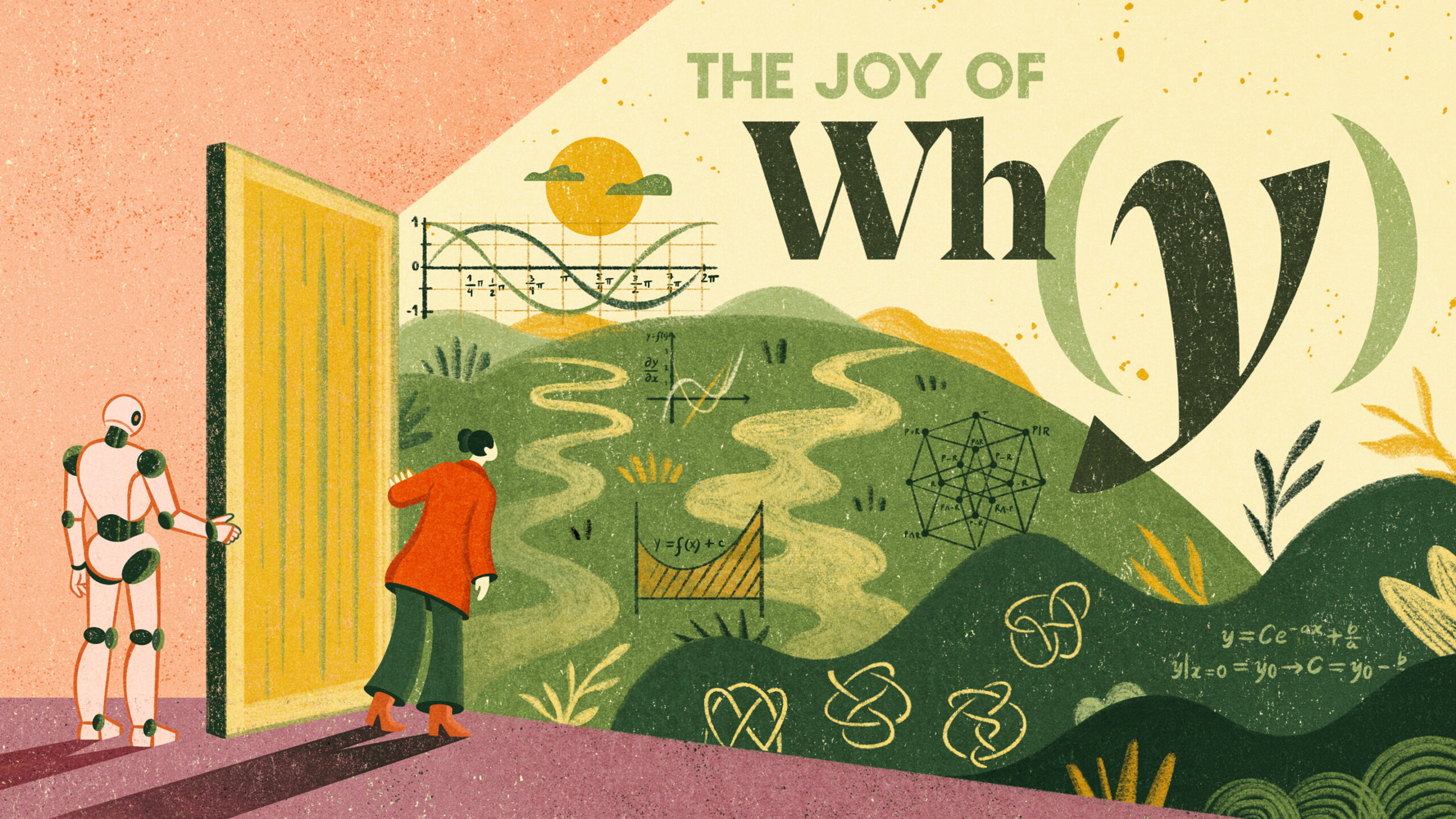
Chanelle Nibbelink for Quanta Magazine
Introduction
Mathematicians are witnessing a profound shift in their field. AI systems are now producing proofs, spotting connections between distant fields, and, in a few cases, solving problems that had stumped mathematicians for decades. The pace of progress over the past several months has raised challenging questions: What can AI systems actually do? And what happens to the more human, creative aspects of the field once machines can match – or exceed – people at problem-solving?
In this special live episode of The Joy of Why, recorded at the International Congress of Mathematicians in Philadelphia on July 26, 2026, hosts Janna Levin and Steven Strogatz are joined by three mathematicians responding to the rise of AI in math: Akshay Venkatesh at the Institute for Advanced Study; Ravi Vakil at Stanford University and president of the American Mathematical Society; and Alex Kontorovich at Rutgers University. Together they discuss what recent AI-generated proofs really demonstrate, what will be gained and lost as mathematics becomes more machine-assisted at the frontier, and what this means for the next generation of mathematicians. The conversation turns to a deeper question: What do mathematicians value about doing mathematics in the first place? The answer involves grappling with what proof and understanding really mean, and the surprising importance of storytelling.
Listen on Apple Podcasts, Spotify, TuneIn or your favorite podcasting app, or you can stream it from Quanta.
[Audience applause]
JANNA LEVIN: Thank you so much for being here. I’m Janna Levin.
STEVE STROGATZ: And I’m Steve Strogatz.
LEVIN: And this is The Joy of Why. Welcome to our first live.
[Audience applause]
STROGATZ: Yes, The Joy of Why, a podcast where we consider some of the biggest unanswered questions in math and science today. And we’re very excited to be coming to you from the International Congress of Mathematicians 2026.
It really does feel like a historic moment. The stakes are pretty high for the future of math. And we’ve had a good run for three, four thousand years doing this on our own. But there’s a new kid in town — artificial intelligence. And it’s starting to play with us, and our field.
And so we’re excited to hear what our panelists have to say about the interaction between math and artificial intelligence, now and in the short term and maybe in the longer term.
So let me introduce our distinguished panel here. First up, I see Akshay Venkatesh from the Institute for Advanced Study. And next to him, we’ve got Ravi Vakil from Stanford University. And rounding out the panel, there’s Alex Kontorovich from Rutgers. All right, Janna, do you wanna get us launched in our discussion?
LEVIN: Yeah, I thought maybe we’d start with some of the recent advances that gave some mathematicians pause, while others were very blasé and unimpressed. I’m going back to the 2024 International Mathematical Olympiads when AlphaProof achieved a silver medal, and then later in 2025, a more advanced model with DeepThink achieved a gold medal.
I first want to ask before we get into exactly how it was done, how many of you participated in the International Mathematical Olympiads back in your day? You did? You did? And will you tell people about it? ’Cause some of our audience might not know it’s, six problems, nine hours, two days, and high-school-aged competitors. Tell us what it was like.
STROGATZ: I’ve heard that Ravi was a terror at this. Jordan Ellenberg was talking about how you used to kick his you-know-what at that competition.
LEVIN: Yeah, people at the conference have been talking about how you terrorize them.
RAVI VAKIL: So, so I first, I first met Akshay at the event, I should say, although he may not remember.
AKSHAY VENKATESH: I don’t. Sorry.
VAKIL: Exactly. Because he was quite young. Uh, but it’s one of the many roads into mathematics. There’s no royal road to mathematics, but this is one of the many ways by which we attract people into mathematics, and it’s also a great way of advertising mathematics, and it helps to develop a certain way of mathematical thinking.
Uh, the important thing about the competition isn’t the six people or the problems, it’s how it encourages millions and millions of kids to hone their minds. So, it was wonderful when the models did well. It was really a proof of concept. I think it was extremely interesting, and I think it can both be an amazing milestone reached, while also I think perhaps people might have misinterpreted it.
So, the first time a model answers a question, it’s exciting. A milestone is reached. The first time a student answers a question, it’s exciting for a different reason, because they’ve learned how to think. And the seventh time a model answers a question, it’s far less interesting, and the seventh time a student answers the same question is far less interesting, for similar reasons.
So, it was exciting, and I, I see it as only a good thing, but it did not represent, uh, superhuman intelligence or anything crazy like that.
STROGATZ: No, sure.
LEVIN: And it wasn’t the highest score even in the year that it, it appeared.
VAKIL: Sure, but the next year it was, and next year after it will be, and I’m happy about that, and I’m absolutely not alarmed.
LEVIN: And Akshay, what’s your experience?
VENKATESH: I think Ravi said it well. I think, you know, one unfortunate thing about this is it has contributed to the image, even among mathematicians, of mathematics as a competition, which is not really how I see it. and I think it’s particularly unhelpful at the moment. There’s some competitive drive. You know, when you’re young, you get validation if people think you’re good at something. I have mixed feelings about how healthy this thing is.
VAKIL: As Akshay said, it could be a danger. Everything’s a double-edged sword. People are driven out of mathematics because they think they’re not good because they didn’t do well in a competition, whereas that just makes no sense.
STROGATZ: I’m very taken with your view of this. There’s that old saying about “It’s the journey, not the destination,” and you seem to be espousing that kind of philosophy, but it feels to me like that is also in embryonic form, something we might get to by the end of our discussion today because all of us may have to start wondering, is mathematics about the journey and not the destination?
LEVIN: I, I was going to say for Alex, beyond that, that was 2025. We’ve recently had some major advances recently published. One of the Erdős Problems was solved, and I’m just curious, one, if you were impressed, surprised, and sort of your reaction to that, and if you could set the stage of what the problem was that was solved.
ALEX KONTOROVICH: Sure. Just to make one comment on the IMO, you know, two years ago we had, uh, AlphaProof, that you know, it was one point off of a gold medal. And by the way, no one’s handing medals to these companies. They’re declaring themselves. As, as having, uh —
LEVIN: Right, self-declared gold medalist.
VAKIL: They’re handing medals to themselves.
KONTOROVICH: Yeah. They- yeah, that’s right. Um, and my prediction was that this summer, no AI models would get a gold medal ‘cause none of them would bother competing anymore. So it’s not interesting for them. The fact that I can push a button on GPT 5.6 and get perfect scores on the IMO. So, okay, next. What’s the next interesting thing? That’s not interesting anymore, exactly as, as you were saying.
But let me go back to your question about these Erdős Problems. Okay, so we have problems that we’re working on, and as Akshay said, solving problems is just one small component of what mathematicians do. We find definitions, we find new structures we’re interested in, we create new questions and new problems all the time.
One person who just loved to ask questions and didn’t mind writing them down whether he was right or wrong, uh, was Erdős, and he wrote down thousands of them. And, thankfully, Tom Bloom, for whatever reason, several years ago decided to collect these into a database.
And what happens sometimes in mathematics, in fact, it happens with some frequency, is that problems that we thought were difficult end up being not nearly as difficult as we thought and doable by existing techniques if you only bothered to look at that problem and, uh, had the background necessary to apply the techniques that end up cracking it and making it easy.
And so what AI is amazing at is: you give it 1,000 problems, and maybe it has a 1% hit rate, and that’s 10 good papers a year, which is a fantastic, uh, career in mathematics. So, right now we’re seeing every day more and more of these Erdős, uh, style problems being announced. How many of them are actual solutions as opposed to maybe partial progress or complete abject nonsense ’cause it’s just LLMs saying things, is one thing.
I think what you’re referring to is the Erdős unit distance conjecture, which is something that quite a lot of people knew, quite a lot of people worked on. There was very significant, progress trying to, you know, get this constant to the conjectured value. And, it turns out that the conjectured value is just wrong.
And, autonomously, uh, GPT found a counterexample, you know, constructed a solution where this exponent is not satisfied. What to me is most interesting about that, I mean, first of all, it’s brilliant. It’s fantastic. This would be a really great contribution if it was a human being that came up with this counterexample. Um, the most fun thing about this is, a week later, a completely unrelated problem called the sum-product problem was also solved in the negative by human beings who were applying the ideas, the techniques that were exposed to us from this AI solution.
LEVIN: Yeah, so interesting.
KONTOROVICH: So this, to me, is sort of the hopefully golden age that we’re going to enter. We’re gonna learn all kinds of amazing mathematics thanks to these techniques. But what is it? “If a theorem falls in the woods and no one cares, you know, does it have any value?” kind of thing.
So I don’t think theorems have intrinsic value in the universe. Mathematicians value them, and right now, AI companies value them because they’re great at marketing. They’re a great way for them to say, “Hey, my tool is better than the previous tool and all the other tools out there.” And it is very effective in that sense, and I think pretty soon AI companies will need other, you know, things that actually bring value to the world, which theorems do not, except for to mathematicians. So but in their wake, they’ll leave us a fantastic tool to learn lots of amazing facts.
LEVIN: I do worry that the ability to generate so many proofs that could be wrong could be a sinkhole for mathematicians, that there is now an industry of just checking those proofs.
Do any of you find yourself lured by the attraction of checking some of these proofs? I mean, some of our very prestigious colleagues have done that, right, have offered their services. Would you ever do it, Akshay? To referee like Terry Tao did.
VAKIL: 100 AI slot proofs. Would you, would you, would you sign up for that?
KONTOROVICH: How much would someone have to pay you?
STROGATZ: There’s a lot of glamour. Come on, how can you resist?
VENKATESH: But this is, I think, adjacent to a very real problem in our community, which is about the functioning of journals and how they will manage in this. So I think as a community, there are a lot of systems that we have to be looking at which are gonna be placed under immense strain.
STROGATZ: Hmm.
VAKIL: Right. Part of the issue is that people are not gonna be lining up to do this. The reason they’re under strain is we’re being flooded, where the flood is only beginning of a large quantity of material, some of which, really amazing things are happening. And also, I have in my inbox during these two hours, I’m not looking forward to seeing what kind of AI slop people are gonna send me, what amazing things they think they’ve proved. And to be honest, I’m not going to check them. It’s not fun.
STROGATZ: It makes me think a little of this, um, trifecta that Terry Tao has been mentioning about concepts like proof generation, proof verification, which is what we’re talking about now, and also proof digestion, where we start to make sense of these proofs in human terms and can assess whether, how interesting they are. But I’m wondering if there might be another category of proof marketing.
VENKATESH: Well, I think I wanna also even question the assumption that proof is the central activity.
STROGATZ: Okay, go on.
VENKATESH: Well, if I think about, you know, if I’m doing a piece of math, I probably think of it more akin to storytelling. You know, I’m trying to tell a story. Uh-huh. You know, perhaps the proofs are part of the grammar of that.
That’s, you know, something that we should be thinking about. Like, should we define this discipline by proofs? And of course, we have done so, but I’m not sure it really matches with what we value and what we’re doing.
VAKIL: I’d also like to strongly endorse what Akshay’s saying, ’cause I feel like… I also think this is what we have always valued. This is not a change. This is something we’ve always valued, and we’ve had various proxies, and we’re forced to examine these proxies because of the change in technology.
But human understanding and the storytelling, My graduate students, they’re brilliant already. What I teach them, it’s the storytelling. Learning how to do mathematics, is when you write a paper, you have to understand the human understanding and the conveying of the understanding. I claim this is what we’ve always wanted.
There have been brilliant mathematicians who’ve had ideas that went nowhere because they could not convince people of them. And there are other people who’ve really changed fields who’ve just been excellent. Erdős is a good example of someone who’s changed mathematics, or there even, on a very different level, Martin Gardner is someone who probably has advanced mathematics much more than most people because of what he’s managed to do by storytelling.
STROGATZ: I think storytelling is not a term that would occur to most people, so I think you’re on the hook now, both of you, to explain to us what are you talking about?
VENKATESH: I think that that was the best, uh, word I could use for the process of You know, I’m working on something. There’s some landscape which I’m exploring, and there are all these things in that landscape, and I’m sort of thinking, “How will I tell a story that will be interesting and engaging for my colleagues?”
LEVIN: Is that how you’re drawn to problems? I mean, math is one of the last places people with a straight face talk about beauty and elegance and, in this case, storytelling. Can you give an example of that for somebody who’s not familiar with the idea that this is beautiful or narratively powerful.
STROGATZ: Ravi, you, you look like you’re ready go.
VAKIL: I would say I cannot think of a major advance in mathematics that does not fit this paradigm. Let me just take Fermat’s Last Theorem as an example. What makes Fermat interesting and Goldbach far less interesting. Uh, It’s because Fermat is part of a long and rich story. People started to dig into it and, in the 1800s, it led to the opening of lots of rich questions. And to be clear, it was beautiful, but it also was powerful. The thing about mathematics is when you have an amazing story that is beautiful empirically. I don’t know why the universe works this way, but when you understand something and the story becomes simpler and simpler, you get something which is more and more powerful.
And there’s no question what the developments from the 19th century have led to in technology and science and in our standards of living. But it’s because people were curiosity-driven and so Fermat led to the development of a good chunk. Well, not alone. It’s part of a grander story.
And then the final proof, it was way better the way it turned out because it required the building of a far more interesting story with dramatic bridges that had no right to be there between one way of thinking and completely different way of thinking. And they were completely out of reach until they weren’t. Until you had dramatic leaps of thought. There were cliffhangers. There were examples where it looked like we were all done, and then, uh-oh, we weren’t. And then the story is not over.
Once you finish the book, you put the book down, and the best theorems are the ones where you’re waiting for the next volume. And everyone is talking about it around the world to try to think of how the story continues. It’s hard to think of an example where things do not fit this.
STROGATZ: Uh-huh. I would like to just try to sharpen up this idea of story. You’re talking about the interconnectivity across time and across disciplines of math. That math is this amazing, often sort of subterranean thing that occasionally pops up above the surface and we can see peaks, but we d-didn’t realize that there are these subterranean branches connecting parts that are invisible until… Okay, I’m my metaphor’s getting mixed up here.
But, uh, it’s something about that, that when you talk about a story, you mean something about the coherence of the subject, I think. Uh, but I don’t know. You wanna try to unpack that better than I just just did, Alex?
KONTOROVICH: Maybe one way of saying it is that the question of Fermat’s Last Theorem, you know, this X to the N plus Y to the N equals Z to the N, has no consequences whatsoever in the universe. No one really cares if it’s true or not. You know, if there was some counterexample, would it destroy something about the universe? Well, it turns out it would destroy something about the universe. It would destroy the Langlands program. Uh, but, um, but that, that was a, a theorem that had to be proved.
But I, I think that question led to a series of other absolutely amazing breakthrough discoveries. From the very beginning of that question, it led to the understanding of non-uniqueness of factorization in number fields, and the fact that we have to understand number fields as their own entities and so that one question, if all you think about is, “I wonder if that’s true or not,” for no reason whatsoever, and you just follow the thread of that story from one breakthrough to another, you get all the way down to, you know, this, uh, massive Taniyama-Shimura and, and so on, and Taylor-Wiles breakthrough. So that’s a beautiful arching, overarching story, and we have many of these in mathematics.
Just to give one more, you know, the question of whether the parallel postulate, this fifth postulate in Euclid’s elements, can or can’t be proved from the other four. Seems like the most esoteric, useless thing. Who the hell cares, uh, if the fifth postulate can or can’t be proved from the other four? It’s not like, we’re not even arguing about whether the fifth postulate is true or not. We’re saying, you know, should it be a theorem or should it be an axiom in the theory? And you follow the thread of that question 2,000 years all the way to Einstein’s general theory of relativity.
LEVIN: And it very much matters to the universe.
KONTOROVICH: Exactly.
STROGATZ: In that case too. So Akshay, I feel like you really tapped into a rich vein with putting our attention on this concept of mathematical stories. I’m also wondering, since you seem to be saying that proofs are not the zenith of what we’re after, insofar as they can contribute to an unfolding story or a richer story, yes. But what about this thing that we say in math when we say something is morally true? Like before we have a proof, maybe even before we have a precise statement, we sort of know what’s going on. Can you talk about that, what that feels like, and what, do we mean by that?
VENKATESH: Oh, uh, yeah, absolutely. You know, like, just to give an example of my experience and probably of many other people in the room, right? When you write a paper, you know what’s right long before you fill in all the details, right? You grasp an intuition. Gaining that intuition is really the most enjoyable part. And it’s sometimes mysterious how that intuition operates and, and how it fails sometimes. But yeah, it is in a way, it’s, it’s much more fun to know something without knowing how you know it.
LEVIN: Well, isn’t there a sense where choosing a problem invokes that intuition?
VENKATESH: Yeah, absolutely, right? you don’t know what’s there. But you have a sense. You have a sense that there’s some richness there.
LEVIN: I guess, Akshay, I would also ask similarly, are, do you care either way if a proof if it’s coming from a machine or if it’s coming from an elder or if it’s coming from a young upstart? Does it matter to you where it came from?
VENKATESH: You know, I certainly don’t see why a machine couldn’t produce, something I found interesting. But I also think as we use machines, it will change those notions very rapidly. So it probably doesn’t make a lot of sense to look at what we value now and ask, can machines do them? It may be more interesting to think how it’ll change what we value.
I mean, the fact that so many of us are using AI in different ways as part of our regular research, I I think it shows you the practice of mathematics is in flux.
STROGATZ: So at this point, I’d like to ask a question that I feel is sensitive, but I think it could also be very interesting, which is here at this meeting and in conversations I’ve been having with people before I came to the meeting, there seem to be certain taboo subjects, things that we probably should be talking about that we’re not, as a community, and also things that I feel like a lot of us are worrying about, but we don’t say out loud.
VENKATESH: Okay, Ravi has to answer this.
STROGATZ: Anyone like to– As president of the American Math Society, Ravi. No, you don’t have to say anything, you’re the president…
VAKIL: No, no, no, no, I won’t be circumspect at all. But there are no taboos. Uh, So I think things people worry about in public or, or on social media are not the things that we should be worried about. I’m less worried about those.
I do think there are things we should be very worried about. I’m worried about younger mathematicians, I think. And the good thing is the community, at least uniformly, seems to realize the danger to the profession comes from the threat to younger mathematicians. But the threat isn’t the obvious one.
First, I need to say in practice, the evidence so far is that technology has always accelerated science in history. I can’t think a single time in history when it’s been disastrous for science. And currently the evidence is that it’s been positive. We’re in a period of great transition, and the error bars are huge, and I make no guarantees for the future. And so there’s uncertainty and anxiety, and also opportunity.
But that’s not what I’m worried about. What I’m worried about is, is this is being used as a pretext, as a Trojan horse for anti-intellectualism, which is that people are coming with pitchforks and torches to burn down the library. And we worry that maybe in a few years, what if this leads to disastrous cuts. You could imagine in five years, graduate programs might be cut by huge amounts. Funding for science might be cut. But that’s actually happening right now. And the pretexts for it don’t make sense.
So when people say it’s because of AI that we have to cut funding for graduate students, reduce jobs, cut REUs, that we don’t no longer need to teach kids how to think mathematically because they can just Google it, they no longer need to understand science because they could just ask a model. So the danger is that it’s a Trojan horse for anti-intellectualism, and it’s already happening. And we’re fighting the cuts right now. So that’s, that’s my first real danger and so, yeah, I mean, it makes no sense.
So the second thing I’m worried about is students learning. We talked about earlier, just fighting with a problem over weeks and maybe never solving it. And there’s a reason why you don’t want all the answers to be the back of the book, and now you have the temptation. The danger is that some of the tools, the problem sets to think over a week, now we have to really trust students to work on their own, and the purpose of it is not to get the answer. It was never to get the answer on a test. It was to train your mind.
The best students, and I don’t mean the smartest, but the wisest students are gonna be accelerated. They will learn faster because it will give them clues as to how they should struggle with problems for longer. But I worry that a large number of people will think they understand something. That will lose a large number of very bright students who will think less clearly because of the existence of…
LEVIN: There’s an anti-correlation between homework scores and test scores.
VAKIL: Exactly.
LEVIN: Yeah. And that’s become very clear. Students are getting 100% on all of their homeworks ’cause they’re using AI. So they go into a test, yeah, that’s timed. They understand none of it.
STROGATZ: Wow.
LEVIN: That’s the way it’s working.
KONTOROVICH: Scores coming in bimodally. So there are the people who use AI to help themselves understand when there’s something that they’re confused about and they don’t really know where to go to learn it…
STROGATZ: Right.
KONTOROVICH: … and then there are the ones who use AI to do their homework. And you can see then on the tests, you know, it’s no longer a single Gaussian. It’s sort of a double peak. One peak is concentrated around the students who are really using that AI to accelerate their understanding.
STROGATZ: Uh-huh.
KONTOROVICH: And train their brains in exactly the same way that we trained our brains, except, you know, when we would get stuck and I just even don’t even know what this word means and have to wait five days to ask the professor in office hours, they can ask the AI right now. And so that’s the way in which they’re accelerating their education. As opposed to the students who just put the homework into the AI. They have the answers, great, and then they’re failing the test.
But you know, it’s interesting, we mathematicians should have the longest time horizon over which to understand how education interacts with technology, because pocket calculators have been around for 70 years or something, and we all know educators who tell their own students, “You don’t have to know your times tables ‘cause a calculator will do it.”
VAKIL: I mean, it seems a truism. We’ve gone through this with calculators and there’ve been a lot of silly debates, but one thing which seems undeniable is the best person with a calculator is the best person without a calculator.
STROGATZ: [laughs] That’s a good aphorism, I think that’s right.
VAKIL: So, uh, we’re not afraid of calculators. Gauss made these huge long, uh, tables and we no longer have to do these things, uh, and that’s good. Uh, but we still develop number sense. We change what we do. We don’t do exactly the same things. And similarly, as Akshay had said, we’re gonna change what we value. Our long-term goals are the same, but we’ll change these things.
KONTOROVICH: And it may not be good because if Gauss hadn’t made those tables, he may not have noticed the relationship between the growth rate of the primes in a range versus the logarithm function. So there, there are all kinds of insights that I think we stand to-
VAKIL: We lost.
KONTOROVICH: We potentially…
VAKIL: It’s a trade-off.
KONTOROVICH: It’s definitely a trade-off, yeah. And I think it’s the trade-off that I will take- Yes … uh, to have the technology. But, you know, there’s no solutions. Everything is a trade-off here.
STROGATZ: Well, let’s focus a little bit on this question of human understanding. It’s a theme in some of your talks. Akshay, I’ve seen that you’re concerned about this. What will be lost and, and what could maybe be gained as math interacts more and more with AI at the frontier and even just in everyday life?
VENKATESH: Right. I, I think, something I would hope is it would lead to us, in fact, putting much more value on human understanding.
STROGATZ: Mm-hmm.
VENKATESH: Human understanding is human, right? It’s subjective. And I think math has this dual heritage of being a science and a humanity.
STROGATZ: Yes.
VENKATESH: And we have, uh, certainly in my lifetime, probably certainly since World War II, I think emphasized the scientific, right? We think of ourself as a science because it’s easier to get funding. That’s where the resources are. Uh, no, I mean, right. But, um- What I would like to see is, is really a, kind-of embrace the humanistic aspect of math. That’s a possible response to AI, which I think would be very nice.
STROGATZ: Mm-hmm.
LEVIN: Steve and I sometimes talk about this, at the advent of supercomputers, there was a similar kind of hysteria that the supercomputer would replace the physicist or the scientist. And of course, producing a string of numbers is not human understanding. It’s meaningless to us.
So we don’t consider the problem to be solved by the supercomputer. It’s the human who adapts it in a way that, as you said, as human beings, we’re able to appreciate it, understand it, and integrate it into the larger sphere of knowledge.
And we’re not computer scientists, of course. You’re not a computer scientist. But just wonder if at any point, do we think the AI will understand? And will that understanding be completely different than the way in which human beings understand?
KONTOROVICH: Why are you guys looking at me?
LEVIN: [Laughs]
KONTOROVICH: There’s a, There’s a number of ways to try to answer that question. You know, will the AI be conscious? I have, I have no idea, Uh, who knows? I like to think of, um… I think it was Richard Feynman who said a long time ago when speaking about technology and the way human beings harness technology that we see in nature and try to make it our own. And he pointed out that the way a bird flaps its wings is not at all how we figured out flight. And so, we have a completely different system that gets us from point A to point B in the air.
Presumably we looked at birds and dreamed up such a thing. And, um, maybe in the same way, you know, uh, depending on what our goals are, we’ll, we invent technology that doesn’t look exactly the way nature figured out to solve that problem, but solves it slightly differently. And so that’s kind of what LLMs have become, is this alternative mechanism by which we can do a small part of what mathematical practice strives for.
Does it mean that it understands? I don’t know what the word understands means in this context.
STROGATZ: No.
KONTOROVICH: And it’s all… you know, Turing never said, uh, what it means to understand language. He just said, “Does it look like language? Does the thing talk to me the way… and I can’t tell if it’s a human or, or a machine.”
So in the same way, maybe I’m even more pragmatic about it. Is the AI useful to me in what my goals are? My goals are to understand mathematics. I wanna learn new math every single day. Is using AI helping that goal or not? To the extent that it’s helping, I’m gonna use it, and to the extent that it’s not, I’m gonna stop and go for a walk and, you know, play ball with my kids, or something.
STROGATZ: I like your operational question, can they be helpful to us? And I think the answer’s already in, that yes, of course, they’re helpful.
But the part that I feel is, back to my list of taboo questions, is what happens when they’re not useful to us because they could do everything that we could do except much, much better. So I, I will stipulate, but maybe you won’t agree. But I think it’s obvious that not only will they be able to solve problems better than us, they’ll be able to ask questions that we will find interesting. They’ll be able to do exposition better than Martin Gardner and the whole thing. Will it still be fun for us to do math?
VAKIL: Well, well, I think you said two flavors of things, one of which was very reasonable, the other of which was very different.
LEVIN: [Laughs]
STROGATZ: Go ahead. What were those? [Laughs]
VAKIL: So yeah, so on one hand, you could say, okay, o- o- once you postulate reaching the singularity, then I feel like all bets are off, and then it’s not really worth having a discussion.
STROGATZ: Because it’s so hard to know what will happen next, you mean?
VAKIL: Or, I just feel like the debates post-singularity tend not to have much value. You didn’t use the phrase superintelligence. Anytime that gets used, I personally feel those are less useful discussions because of the lack of definitions.
But then you said things that were very reasonable because they were precise, and they were statements about evidence of, they will be able to write things that will be interesting. And those things were already here. That time has already come, and I think they are already telling us.
STROGATZ: I’m not hearing that they’re already here. I hear people saying things, you know, again, ’cause this is a, I feel like a sociological question. What are we talking about privately? And I, I hear that we can still have taste. We’re better at knowing what’s interesting.
VAKIL: Ah, okay, so…
STROGATZ: And I’m claiming that that’s only for the short term.
VAKIL: So, so obviously, there might be a new technological advance, but with the way things currently work, anything you can hill climb, it can hill climb. If there’s anything that you can have enough examples of it can improve. We train currently students to try to deal with the unknown, the situations that they have never seen anything like before, which is by definition the thing you can’t sort-of train for.
So, is someone gonna predict that a Pulitzer Prize-winning novel will be written by an AI within three years? I’ll put $20 against you on this. And people have made bets like this in the past, and they’ve lost those bets every single time. We were supposed to be on Mars by today if you listen to certain very wealthy people 10 years ago.
So, absolutely large quantities of acceptable material I expect to be very useful. And I’m not belittling it. This will change everything, uh, will happen. But I think the way things are currently happening is outstanding things are going to happen, and AI is involved, and humans are involved. And, uh, I guess people are claiming that a time will come when there’ll be no more humans, but they need some evidence.
VENKATESH: I very much agree that we have to be very careful about the premises. But let me give a, just let’s suppose we’re in this world where AIs can prove things, they can write questions that we find just as interesting.
You know, like when I arrived at grad school, right? I met all these people who were just much better at math than I was. And at that time, I was like, “I’m never gonna be as good at math as these people.” But this is great. I get to study this field. It’s a beautiful field. I’m not gonna be the best at it. I’m happy to spend my life this way.” So I, I think you know, yes, we will still do math because it has some basic value to us as human beings.
LEVIN: I mean, I think Akshay’s point is crucial. And also to your point about students and the, the threat really to the young student is attitudinal. If they think there is no pleasure here, no joy here, no discovery. Not just a career or being the best, but becoming a mathematician is no longer on offer and the hard work that it’s going to require and having to resist looking up the answers in the back of the book, which is to say to ask one of the models. And so how are you imagining addressing this to have the next generation of mathematicians survive?
KONTOROVICH: So I’ve been trying to explain to my students sort of three scenarios, three vignettes, as an analogy to exactly this question.
Vignette number one, uh, you have some heavy pallets and you need to move them onto a truck. So you get a forklift, you drive it over, you lift the pallets, you put them on the truck, end of story. Okay?
Scenario number two, you’re trying to learn how to use a forklift. So you get in the forklift and you move some pallets, not because they need to be moved from point A to point B, but because you’re learning how to operate a forklift.
Okay, scenario three, you decide you wanna get a, a little workout in. You go to the gym, you put 200 pounds on the bench press. You get in your forklift, you drive over, and you do 10 reps with the forklift. One of these is the wrong use of technology.
[Group laughter]
Okay? So if you just explain to students, why are you here? What are you… You know, if I don’t need to know the answer to this real analysis homework. I know how to do this. It’s in the back of the book. Before AI, you could Google the answers. Okay? So, uh, what is the purpose of this operation? Is it for you to learn how to use that technology, to learn how to prompt AI to solve real analysis problem? Is it that I want the solution to the problem, or is it that you’re supposed to sit there being frustrated and get the stamina for frustration that it takes to do any kind of difficult thing that human beings want to do?
If that’s what the goal of this exercise is, then either sign up voluntarily to do the exercise the way it’s designed, or drop this course ’cause that’s, that’s what I’m trying to teach.
LEVIN: Yeah, I think the gym analogy is pretty good. I do think it’s very interesting, I once had to try to solve Einstein’s equations for a black hole solution, not because it wasn’t solved already or because I couldn’t find the answer somewhere. And it was a great moment in my life, right? Going through that process. But I think there’s gonna take some convincing for this generation that’s growing up on AI.
STROGATZ: It’s interesting your example because this has always been a little bugaboo of my own, that there are people who talk about high school geometry is worthless, say the people who don’t like math, but geometry will teach you to think. It will help you develop logic and patience and blah, blah, blah.
I don’t like that defense of geometry. Geometry is a magnificent creation of humanity, and this is like, you know, you could play soccer because you wanna exercise your leg, or because it’s the beautiful game, you know?
And so math to me, the content is beautiful. It’s not just the calisthenics that I wanna make myself stronger for solving a problem for a finance company, ’cause that’s what really matters. I wanna do it for human flourishing, like Francis Su would say. Like what I think you’ve been pushing, Ravi. Not just for my own bulking up because the content is inherently rich and makes me a happier person before I’m dead. What’s the meaning of life? I wanna do math while I’m alive.
VAKIL: And I like that we can have both. I like the fact that soccer in the United States is played in middle schools en masse, and you have fun. You’re with people, and you s- and they’re secretly, of course, getting healthier and stronger by enjoying it and building habits. You know, so this seems a great model for similarly doing geometry to support similar things at the same ages.
LEVIN: This might be very unpopular, and I apologize to the mathematicians ahead of time.
STROGATZ: OK, don’t ask…
LEVIN: But there’s a belief that if all of human knowledge is wiped out tomorrow, not humanity, but human knowledge. That eventually we’ll all be rediscovered. One plus one is two. If human knowledge was wiped out tomorrow, the AI stops.
STROGATZ: But what happens to the human…
LEVIN: It’s got to start over.
KONTOROVICH: No, but there’s a version of this question which you can ask right now, which is, okay, so there are these… we didn’t get into formalization in interactive theorem provers, but if you take any interactive theorem prover which has the logical axioms of inference, logical inference from one state to the next, and you seed it with nothing, like AlphaZero. You’ve just given it the rules of chess, and you say, “Play a trillion games, and it comes up with, you know, its own theory and its own evaluation of states and so on.
If you seed an interactive theorem prover with no library of what mathematics is.
LEVIN: Exactly.
KONTOROVICH: and you cut an AI loose, will it discover a proof of Fermat’s Last Theorem?
LEVIN: Right. Without the reinforcements and…
KONTOROVICH: Yeah, without giving it any human knowledge, without, without anything. So that is, uh, I think Peter Sarnak is popularizing this question. You know, is there, like, a MathZero? Could someone train an AI to actually do that? That’s the real question that we have an answer to at the moment.
LEVIN: But we know humanity could do it. I mean, yes we’ve done it once, we could do it again, right? But it, it also sort of harkens, and I think this was the part I was concerned about mathematicians wouldn’t like, to the “discovered” or “invented” question. Are these discoverable truths that an entity that thinks entirely differently from human beings could discover?
VAKIL: Sure, and you can imagine being the first human being to see a lake wandering in the woods in some new island that’s discovered. Both can be true. That there’s joy in human discovery and also maybe a drone would fly over the island and discover the lake.
STROGATZ: Well, I think this is the place where we turn it over to the audience. You’ve been patient, and I appreciate, our panel taking some pretty wild questions from us. They may get even wilder here. We’re ready when you are please.
Audience Question: So far, AI is controlled by private companies, and access to the best models is increasingly being gated by financial resources. And I’m concerned about this divide between researchers who are going to have access and those who don’t. Historically, our field has been known for all you need is pen and paper. To what extent will that no longer be true, and how can we make sure math is still accessible to everyone?
KONTOROVICH: There are a lot of groups that are working on open source analogs. Of course, they’re behind, but they’re catching up. I’m on a team that’s working on open source models that solve math problems in particular, or help mathematicians formalize mathematics and so on. So people are, uh, are very concerned about this. They’re working on it. It’s hard. We need more resources. We should always say we need more resources.
STROGATZ: We can always say that.
KONTOROVICH: Yeah.
Audience Question: My question is, I think there are some missing pieces. Now, as AI begins churning out proofs, I think we are realizing that this is not the- what mathematicians want, just like the number of proofs. I think the missing piece I feel is aesthetics. And we haven’t really defined that.
Like, why is a problem interesting or why is a proof interesting? Where is the beauty? Where is depth? Where is interconnectedness? I think because these haven’t been defined, when you’re faced with hundreds of proof generated by AI, you have no idea what to look at. So, is somebody working on, like, measuring these?
VAKIL: I will go the other direction and say that y- y- y- you might be saying, “Can we mechanize aesthetics so we can measure what is the most aesthetic proof?” And I, I don’t think that’s the direction to go.
We already have a good human sense as what’s aesthetically pleasing. We know what’s interesting. We know most of the proofs that are produced by AIs are not interesting. We know some of them are fantastically interesting and beautiful.
So I don’t think it’s mechanizable, and that pleases me a little bit that, it’s a human subject, that it’s a human understanding that matters. I realize that’s not a very happy, it’s not like a very conclusive answer, so maybe I should pass it to someone else.
KONTOROVICH: I’m just gonna say the, the various ways that other sciences try to mechanize quality by, you know, citation inde- you know, H-index and these kinds of things, uh, which in mathematics are almost, you know, have zero correlation basically.
I’m really happy that our field is not looking at metrics and there are Fields Medalists with an H-index of four or something. These, these things are completely meaningless. Uh, it’s a problem when we have to go to the dean and say, “No, no, this person really is very good. Please look at their papers,” which the dean will not understand.
STROGATZ: Uh-huh. Oh, go ahead please.
VENKATESH: No, I just say as mathematicians, I think we should be very conscious of the use of numbers to stand in for another concept, and we remember it’s really this other concept we’re interested in.
VAKIL: And we have interesting debates in the mathematical community, which I enjoy, about is this interesting or not?
VENKATESH: Right.
VAKIL: It’s not like there’s a single metric, this theorem deserves a 3.5 on the scale. But instead, you know, we’ll argue, we’ll have interesting discussions over coffee that, “Oh, this was really something,” and “Actually, I wasn’t that impressed.” It’s a very human measurement system. Some would argue then that it’s open, it’s ripe for abuse, which it absolutely is. But on the other hand, it also is most people are, doing it in good faith, and there’s the sense of beauty in mathematics.
It is hard to… I don’t think I would want… I don’t think it’s possible to quantify, but it’s something that you meet someone at the ICM from another country, brought up in a completely different school system, and you meet and you hear about a new theorem, and you both nod your head and you think, “That was amazing.”
KONTOROVICH: And different people will have different evaluations of the value, and even the same person at different times will have different evaluations of the same result. I know that there are results that, you know, I, I thought, “Oh, that, I don’t think that’s that interesting,” and then I started learning more about it, and I realized, “No, that’s an amazing breakthrough.”
STROGATZ: [Laughs] So true. Okay, please.
Audience Question: Um, thanks for the great conversation. think unfortunately, historically, the mathematical community has not appreciated exposition and teaching in the same way that it has solving really hard problems. I mean, this goes back to, like, Bertrand Russell describing people that describe math as being less than the people that solve math problems. Do you think this will shift in the age of AI towards an appreciation of pedagogy and of exposition?
VENKATESH: I think yes, for sure.
VAKIL: I think the three of us here would have pushed before AI in exactly that direction. This is not new, but I think so, and I hope so, and I think we should have pushed before, and…
VENKATESH: Yeah, I think this is an example of where, y-you know, the, stress that AI puts on the system will lead to something healthy, something that was healthy quite without the issue of AI.
STROGATZ: That’s an optimistic reading that I like hearing. Actually, that it, it may push us in a direction that we should have gone in before.
KONTOROVICH: I mean, [G. H.] Hardy explicitly wrote, you know, “Here I am in my old age looking back and sort of surveying things,” and surveying is the work of lesser men that, uh… I mean, that’s I think a literal quote.
STROGATZ: Yeah. He seemed to have had a lot of self-loathing. Some of it deserved, I think, maybe, but not all of it.
[Group laughter]
STROGATZ: No, that essay did a lot to damage our values.
VAKIL: That is true.
STROGATZ: We’ll save that for another time.
Audience Question: Thank you for this conversation. I had a question for the entire panel. So the panelists laid out a vision of what AI use in education ideally looks like, right? You ask students not to use AI to train their minds.
But this vision is sort of incompatible with the current infrastructure for like grad school applications or postdoc applications or tenure track applications or what have you, where, you know, it seems like the only thing that matters is how much you publish, how hard the problems you’re solving are, and so on, so on.
How do you see this infrastructure changing? And what is your advice to a current graduate student worried about the fact that not wanting to use AI, say, in order to train their minds, would leave them behind, especially given how slow the timelines of infrastructure changes tend to be?
VAKIL: I’ll begin, but I think what the other two have to say is gonna be very important. I do think part of the system is currently quite robust, and I feel happy that we can deal with it. Parts are going to have to change. I will say, for example, for applications for graduate school, our department now interviews in a way we didn’t, because we want to really see what people know and see the human being. And we ask questions not to test, but see their actual understanding. So, I feel like that part of the system is, is robust. And we’re looking for at every single stage is can you do the best mathematics?
And I do think the best mathematics, some people will do very well augmented by AI, other people will not. I will say to graduate students, if they wonder, “Do I need to use AI?” I would say, “No, currently.” But I would also say don’t be afraid of it if it helps. If you need to look for references, use it in the way you feel comfortable with.
But the evidence currently out, don’t go to Twitter, don’t follow what other people are saying. Don’t be afraid. Uh, what really is happening on the ground is that the people who are using it effectively are using it in a very specific way, and I think the people who are best at it, who will give you the best advice are fellow graduate students who are similarly struggling with it at the same level, where they will say use it to perhaps… track down the thing to do. How do I think about this? But then you go away, and learn who among your peers is learning the fastest, and maybe they’re using an AI to guide them on what to think, or maybe not. And so I don’t think you need to use AI. I don’t think you should be afraid of it either.
VENKATESH: I, I was gonna say the same thing about interviews. You know, I’m also considering a-adding them for postdocs for exactly this reason. I think we, you know, we wanna understand who the person is and language models are gonna make that different, difficult if we just go on unwritten things.
I think the broader question of how systems have to change is, is important. And I don’t know, but I, I think the community is seriously thinking about it.
KONTOROVICH: And just to add, even before AI, it wasn’t a number of publications or your GRE score, it was the letters. We wanna know who the professors are that you’ve interacted with and what is their opinion. So which, you know, is an interpersonal communication and that’s what a lot of the measure was. You know, GRE scores are nice to look at, but I go straight to the letters.
VENKATESH: I think, you know, mathematics has always, I think it’s made space for people who are independent-minded and wanted to go and do their own thing. And I think we will continue to do that. And maybe doing your own thing means saying I refuse to use AI. But, I think as a culture, we respect that kind of independence of mind.
STROGATZ: Nice. Okay.
Audience Question: Um, So one thing that we’ve heard a lot about is how AI is changing the way that we’re attacking these problems, the way we’re thinking really. And I get a little pessimistic and wonder, you know, is it gonna change the way we think in a bad way? I don’t think students necessarily start using AI as a tool thinking, “Okay, I’m going to hurt my knowledge and the way I go about these problems,” but slowly over time it does, and I worry that the same thing might happen to mathematicians.
So my question is, are we really just like frogs boiling in a pot of water? Are we gonna know when we’re supposed to jump out?
[Audience giggles]
VENKATESH: Who knows?
STROGATZ: Who knows!
VAKIL: I think some people will make bad decisions, and the question is if too many do, I, I think that is a real danger, and it’s hard to know how warm the water is, and people will think their homework is due the next day and just this one time, they’ll do it.
So I, I think that’s a fair question, and it’s tough when you’re the person. It’s easy to see it from the outside. It’s tougher when you’re the person deciding.
I feel it a little bit when I learn a new subject with AI that sometimes I get the link to the paper and I get, then maybe I’ll get the summary. But in the old days, I would’ve read the paper and I would’ve fought with it for a few days.
So, there’s a trade-off, and as I s-said earlier, we need to fight with things for a long period of time and be stuck. And I don’t have much time right now, and so I sometimes make this trade-off. But I’m making potentially the same mistake the undergraduate is the day before the homework is due.
KONTOROVICH: I still can’t understand anything without printing it out. So I’m, I’m very old-fashioned in that way, you know. If I’m looking at something on a screen, it’s just going by. I tried annotating PDFs. It’s just not the same as printing it out, laying seven pages across my desk, circling things and, you know. I don’t know. I’m a Luddite… who loves AI.
[Group laughs]
STROGATZ: Yes, please.
Audience Question: Um, As a grad student, I feel, uh, low-hanging fruit is very important for, uh, grad students for, like, getting started, getting confidence in math. And my concern is that AI will swoop, and take all the low-hanging fruit, and then maybe, uh, it’ll be hard for a lot of people to get started. And I’m concerned about like, the Average Joe mathematician who doesn’t work on things that are, like, safe from AI. But, yeah. I was wondering what your thoughts are on that.
STROGATZ: I wonder about that, though. we didn’t get a chance to talk about applied math versus pure math, and maybe you’re in pure math, so this isn’t relevant. But I think even within pure math, isn’t it possible to start a new area sort of? Like, there’s this question of interpolating within math and extrapolating to do something brand new, and I realize it’s hard to start a new subject or even a new tiny piece of a subject, but I’m just thinking that might increase your chances, that it won’t be low-hanging fruit if it doesn’t exist yet. You know what I mean?
Like, there may be tractable graduate student beginning level questions that you could get by talking to your friend who’s a psychologist. I am gonna go applied on you for a minute. We want you in applied math. There’s a lot to do, and science may be more resistant than math.
LEVIN: It’s happened in particle physics. It was a victim of its own success. I mean, this is a different kind of a success. It’s a technological success, but where the standard model seemed done.
STROGATZ: Mmm, okay.
LEVIN: And it was no longer attracting tons of students who had lots of work to do. It was all kind of solved. And then, you know, luckily, we realized we only know 5% of what’s out in the universe, so we’re back. But, you know, dark energy and dark matter kind of saved the fields… the unknowns. So it, it may be that there’s just, as you’re saying, there’s a way of, sort of, pivoting. But it’s very curious for mathematics. I think it is a curious question.
VAKIL: So I wanna express worry as well. I wanna share your concern that this, I think uh, there are certain kinds of problems that would be excellent for training graduate student minds, such as you take a solution, a theorem that worked in a certain situation, and I as an advisor know it’s going to work. It’s got to work in a slightly different situation. And that’s perfect ’cause you would have to really understand it to make it work. But now that really feels something that is accessible to models, and rightly so that now this should be handed over to models.
So, the good thing is advisors are concretely thinking about how next to think about the right way, the right sources of problems. I don’t feel like graduate students are the ones that are gonna invent new fields. Unless, except for maybe three or four.
But, I do worry. That’s the, one of the few things that I think are real concerns. Uh, but at least I share the concern, and we’re thinking hard about it. So don’t give up, uh, because it’s important to get the graduate students through this stage and continue to train because they’re the ones who are going to drive the field forward four years later.
KONTOROVICH: But I think even your example of I know this theorem works in, uh, situation X, I wanna, you know, make a slightly, slight modification X prime. The act of what we’re asking the student to do to transfer from X to X prime, we’re not saying you have to come up necessarily with any new ideas.
The goal is for you to learn actually what theorem X is, learn the innards of how it works, because when you shake it just a little bit, you, you learn some more about, oh, actually the reason this is happening is because of this and not that and you thought it would work, but it actually doesn’t work and here’s where I’m stuck and so on.
There’s still so much, even with the AI assisting you in that path, there’s still so much for you to learn. The goal isn’t necessarily just to arrive at X prime. Now, if you’re saying, “Okay, but AI already knows X prime,” who’s pressing the button on the AI to get X prime, right? At the end of the day, someone has to ask the AI the question, and of course it can ask its own questions, but even then someone’s prompting it to say, “Go ask questions.”
So, it’s like it’s not turtles all the way down. Someone is paying the electric bill of what’s being asked and, uh, that person’s doing it for a reason. At the end of the day, what is being done has to be valued by human beings, otherwise it’s not going to get done.
STROGATZ: And isn’t it possible that we’re in a peculiarly anomalous time right now where the big AI companies are playing around with our field for their own purposes…
KONTOROVICH: Yes.
STROGATZ: … but they may lose interest very quickly.
KONTOROVICH: That’s exactly what I expect.
STROGATZ: Right? So, so in fact, what we’re experiencing now may not last much longer, and maybe we’ll have it back to ourselves again for a while.
KONTOROVICH: And we’ll have this great tool that they…
STROGATZ: And we’ll have this great tool while they’re solving something else.
Well… okay, please, go ahead.
Audience QA: So like many people in this room, I of course agree that math does amazing things to sharpen minds and to enrich lives. But at the same time, there’s a lot of other disciplines that can lay similar claims, and much has been said even today about, you know, humanities and that maybe math is going to start looking a little more like those.
So my question is do you think that as a profession, we need to be thinking about some sort of a value-added statement that would actually work to, in real life, nurture an ecosystem of people who would be engaged in this brave new math that’s being shaped up? Or do you think that such a value-added statement will just kind of happen by itself?
VAKIL: Okay, that was like softly lobbed across home plate. So this is something which is, i-i-is, so this is part of the mistakes that were made with the Hardy style: I only wanna talk to those students who are future PhD mathematicians. That’s decades ago.
At many schools, math is one of the biggest majors. At our school, math is one of the biggest majors. Why? Not because people are going to become PhD mathematicians. It’s because this, these habits of mind, this, way of thinking are empirically, more and more today, even more than ever, are incredibly useful.
Our students, if you want a job where you know what you’re gonna be doing in 50 years, you should not be a math major. If you want to be a job in a career that doesn’t even exist yet, that where you’re gonna make the future, our students rule the world.
In fact, I was just given from the Italian Mathematical Society, they did a study on the value added of mathematics to the economy. This is, incredibly safe, and I think by hiding ourselves and pretending we’re not useful, that’s been really dangerous. I think we need to have an informed public. They want to know math. They want to understand math. We can easily convince them how useful it is if we would just make the case for it. So thank you for that that very easy question.
[Laughter]
STROGATZ: Well, you have been a fantastic audience, and so we thank you. We also thank our panel here. So we’ve been speaking today with Alex Kontorovich, Ravi Vakil, Akshay Venkatesh, and as always, Janna Levin is here co-hosting. We’re signing off from The Joy of Why. Thanks again, Janna.
LEVIN: Thank you, Steve, and thanks to our guests. Till next time.
[Audience applause]
STROGATZ: You turned on the recording?
[Laughter]
KONTOROVICH: Run it again!
[Music plays]
STROGATZ: If you’re enjoying The Joy of Why and you’re not already subscribed, hit the subscribe or follow button where you’re listening. You can also leave a review for the show. It helps people find this podcast. Find articles, newsletters, videos, and more at quantamagazine.org. [email protected].
LEVIN: The Joy of Why is a podcast from Quanta Magazine, an editorially independent publication supported by the Simons Foundation. Funding decisions by the Simons Foundation have no influence on the selection of topics, guests, or other editorial decisions in this podcast or in Quanta Magazine.
The Joy of Why is produced by PRX Productions. The production team is Caitlin Faulds, Jade Abdul-Malik, Genevieve Sponsler, and Merritt Jacob. The executive producer of PRX Productions is Jocelyn Gonzales. Edwin Ochoa is our project manager.
From Quanta Magazine, Simon Frantz and Samir Patel provided editorial guidance with support from Samuel Velasco, Kit Sudol, Simone Barr, and Michael Kanyongolo. Samir Patel is Quanta’s editor-in-chief.
The episode art is by Chanelle Nibbelink, and our logo is by Jacky King and Kristina Armitage.
STROGATZ: Special thanks to Garth Avery at the Cornell Broadcast Studio and Andrew Stelzer for PRX.
LEVIN: I’m your host, Janna Levin. If you have any questions or comments, please email us at [email protected]. Thanks for listening.
[ends]
Note: Alex Kontorovich is a member of Quanta Magazine’s advisory board.